
Article Sidebar
Main Article Content
Abstract
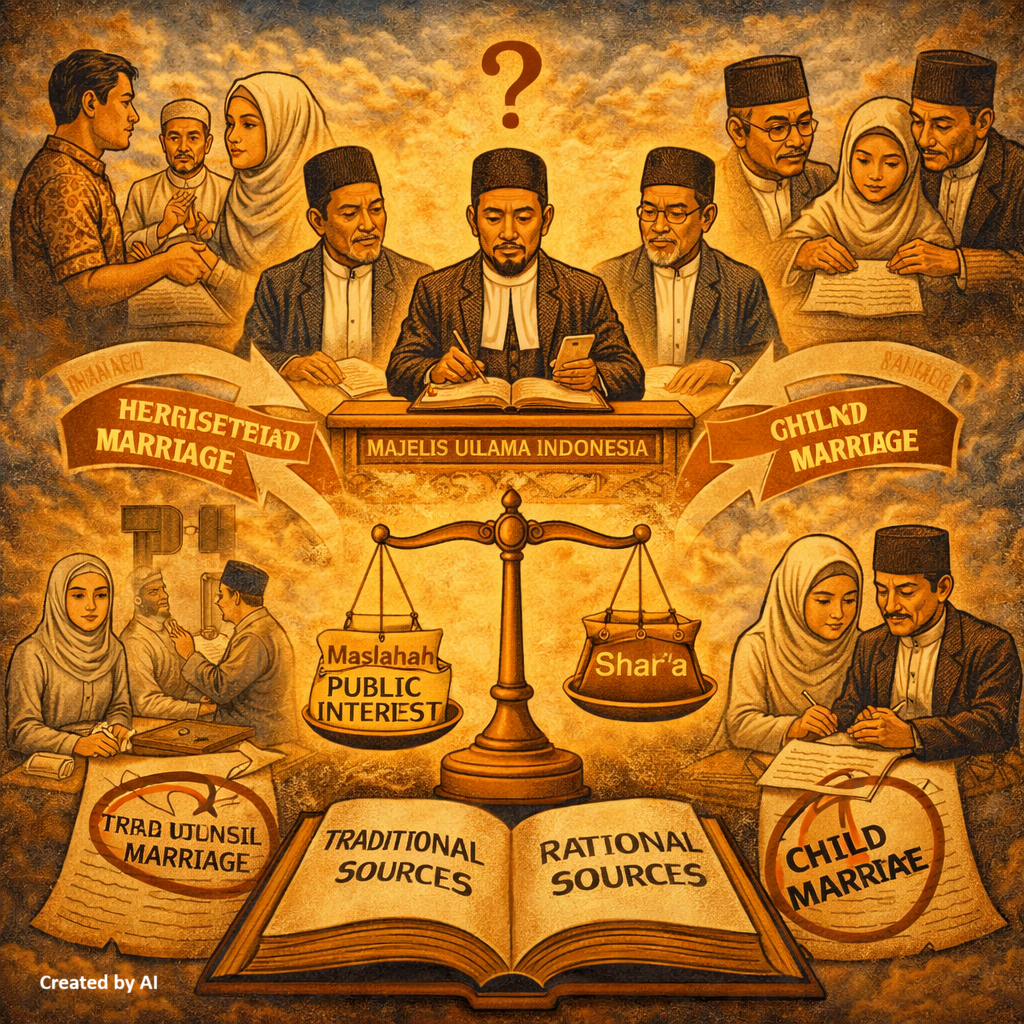
Purpose - This study examines the practical application of theories of ijtihad in the fatwas of the Indonesian Ulema Council (MUI), focusing on the issues of unregistered marriages and child marriage, as well as their impact on the diversity of legal arguments and the consistency of fatwa outcomes. Additionally, this study evaluates the extent to which the maqāṣid al-sharī‘ah approach is operationalized in addressing contemporary social problems.
Methods - This study is a literature review employing a normative-doctrinal approach. The primary data included MUI Fatwa No. 10 of 2008 on unregistered marriages and the 2009 Ijtima’ Ulama Decision on child marriage. Analysis was conducted using content analysis and critical interpretation of the fatwa text, supported by classical fiqh literature, contemporary usūl al-fiqh, and the maqāṣid al-sharī’ah framework.
Findings - This study found that the MUI applies a hybrid approach that combines taqlīd toward classical fiqh and collective ijtihād based on considerations of the public interest. Although the MUI acknowledges the negative social impacts of unregistered and underage marriages, its fatwas continue to sanction these practices based on the opinions of classical Islamic scholars, resulting in key concepts such as harm, maturity, and the public interest not being defined with sufficient clarity. Consequently, the application of maqāṣid al-sharī’ah in fatwas tends to be normative-formalistic and insufficiently responsive to the complexities of contemporary reality.
Contributions/limitations of the study - This study contributes to the discussion of Islamic legal reform by critically evaluating the methodology of MUI fatwas. The study’s limitation is its reliance on secondary data without empirical field research.
Originality/value - This study offers an original analysis of the application of ijtihād and maqāṣid al-sharī’ah theories and underscores the urgency of a more dynamic and contextual approach to Islamic law.
Keywords
Article Details
Copyright (c) 2026 Mukhlisah Amin, Dwi Widyanti Putri

This work is licensed under a Creative Commons Attribution-ShareAlike 4.0 International License.
- Authors retain copyright and grant the journal right of first publication with the work simultaneously licensed under a Creative Commons Attribution License that allows others to share the work with an acknowledgement of the work's authorship and initial publication in this journal.
- Authors are able to enter into separate, additional contractual arrangements for the non-exclusive distribution of the journal's published version of the work (e.g., post it to an institutional repository or publish it in a book), with an acknowledgement of its initial publication in this journal.
- Authors are permitted and encouraged to post their work online (e.g., in institutional repositories or on their website) prior to and during the submission process, as it can lead to productive exchanges, as well as earlier and greater citation of published work.
References
- Abdullah Jarir, Nina Chairina, Masduki, and Abdul Rahim Hakimi. (2025). FATWĀ IN CONTEMPORARY ISLAMIC JUDICIARY: THE ACCOMMODATION OF MUI FATWĀ AMONG JUDGES OF INDONESIAN RELIGIOUS COURT. Al-Mawarid Jurnal Syariah Dan Hukum (JSYH), 7(2), 373–396. https://doi.org/10.20885/mawarid.vol7.iss2.art9
- Al Ikhlas, A. I., Yusdian, D., Alfurqan, A., Murniyetti, M., and Nurjanah, N. (2021). The Theory of Higher Objectives and Intents of Islamic Law (Maqasid Al-Shariah) as One of Instrument of Ijtihad According to Imam al-Shatibi in Al-Muwafaqat Fi Ushli Al-Syari`ah. Media Syari’ah : Wahana Kajian Hukum Islam Dan Pranata Sosial, 23(2). https://doi.org/10.22373/jms.v23i2.10138
- Arief, A., Kurniati, K., and Misbahuddin, M. (2022). ACCEPTANCE OF ASHAB AL-SHAFII ON THE CHANGES OF QAUL QADIM AND QAUL JADID OF IMAM SHAFI’I. HUNAFA: Jurnal Studia Islamika, 19(2), 175–191. https://doi.org/10.24239/jsi.v19i2.683.175-191
- Auda, J. (2007). Maqashid Al-Shariah as Philoshophy of Islamic Law, Asystem Approach. The Internasional Intitute of Islamic Thought.
- Bedner, A., and Van Huis, S. (2010). Plurality of marriage law and marriage registration for Muslims in Indonesia: A plea for pragmatism. Utrecht Law Review, 6(2), 175. https://doi.org/10.18352/ulr.130
- Belhaj, A. (2013). The reform debate: Al-Marzūqī and al-Būtī on the Renewal of Usūl al-fiqh. Ilahiyat Studies, 4(1), 9–24. https://doi.org/10.12730/13091719.2013.41.68
- Butt, S. (2008). Islam, the State and the Constitutional Court in Indonesia. 17(02). https://digitalcommons.law.uw.edu/wilj/vol19/iss2/3/
- Coulson, N. J. (2017). A History of Islamic Law (1st ed.). Routledge. https://doi.org/10.4324/9781315083506
- Duderija, A. (Ed.). (2014). Maqasid al-Shari’a and Contemporary Reformist Muslim Thought. Palgrave Macmillan. https://doi.org/10.1057/9781137319418
- El-Saleh, M. S., Mostafa, I. I., and Shaheen, W. M. (2021). The Effect of Listening to The Holy Qur’an on Improving Some Psychological and Physical Variables Among Yoga Practitioners. Academic Journal of Interdisciplinary Studies, 10(4), 286. https://doi.org/10.36941/ajis-2021-0117
- Fadel, M. (2008). The True, the Good and the Reasonable: The Theological and Ethical Roots of Public Reason in Islamic Law. Canadian Journal of Law & Jurisprudence, 21(1), 5–69. https://doi.org/10.1017/S084182090000432X
- Fatarib, H., Ali, Z. Z., Arifin, N. A., Najib, A., and Fathoni, M. N. (2025). Progressive Legal Reasoning in Contemporary Islamic Legal Reform: Negotiating the Maqāṣid and Hermeneutic Approaches. JURIS (Jurnal Ilmiah Syariah), 24(2), 277–294. https://doi.org/10.31958/juris.v24i2.16123
- Hallaq, W. B. (1984). Was the Gate of Ijtihad Closed? International Journal of Middle East Studies, 16(1), 3–41. https://doi.org/10.1017/S0020743800027598
- Hallaq, W. B. (2001). Authority, Continuity and Change in Islamic Law (1st ed.). Cambridge University Press. https://doi.org/10.1017/CBO9780511495557
- Hallaq, W. B. (2009a). An Introduction to Islamic Law (1st ed.). Cambridge University Press. https://doi.org/10.1017/CBO9780511801044
- Hallaq, W. B. (2009b). Sharīʿa. Cambridge University Press. https://doi.org/10.1017/CBO9780511815300
- Hasanudin, F. (2019). Ijtihad Maqashidi: Methodology and Contextualization of Islamic Law in Indonesia. Al-Mawarid Jurnal Syariah Dan Hukum (JSYH), 1(2), 134–153. https://doi.org/10.20885/mawarid.vol1.iss2.art2
- Hasyim, S. (2011). The Council of Indonesian Ulama (Majelis Ulama Indonesia, MUI) and Religious Freedom. Www.Irasec.Com. http://www.irasec.com/components/com_irasec/media/upload/DP12-MUI.pdf
- Hasyim, S. (2015). FATWA ALIRAN SESAT DAN POLITIK HUKUM MAJELIS ULAMA INDONESIA (MUI). Al-Ahkam, 25(2), 241. https://doi.org/10.21580/ahkam.2015.25.2.810
- Ichwan, Moch. N. I. (2013). Towards a Puritanical Moderate Islam: The Majelis Ulama Indonesia and the Politics of Religious Orthodoxy. In Contemporary Developments in Indonesian Islam: Explaining the “Conservative Turn.” ISEAS Publishing. https://doi.org/10.1355/9789814414579
- Jackson, S. A. (1996). Islamic Law and the State: The Constitutional Jurisprudence of Shihāb al-Dīn al-Qarāfī. Brill. https://brill.com/display/title/2377?srsltid=AfmBOoonX7iC2QE5tLQgjsHywFRr4rLwNuMCk4axrOdQoZH8_ECgEvU8&contents=editorial-content
- Kamali, M. H. (2003). Principles of Islamic Jurisprudence (3rd ed.). Cambridge Islamic Texts Society.
- Kaptein, N. J. G. (2004). The Voice of the `Ulamâ’: Fatwas and Religious Authority in Indonesia. Archives de Sciences Sociales Des Religions, 125, 115–130. https://doi.org/10.4000/assr.1038
- Khuluq, M. K., Mu’allim, A., and Mukharrom, T. (2024). Ijtihad Jama’i, Multi, Inter, and Transdisciplinary Approaches: A New Paradigm of Contemporary Islamic Law. International Journal of Science and Society, 6(4), 468–483. https://doi.org/10.54783/ijsoc.v6i4.1367
- Lindsey, T. (2012). Monopolising Islam: The Indonesian Ulama Council and state regulation of the “Islamic economy.” Bulletin of Indonesian Economic Studies, 48(2), 253–274. Scopus. https://doi.org/10.1080/00074918.2012.694157
- Lindsey, T., and Steiner, K. (2012). Islam, Law and the State in Southeast Asia: Indonesia. I.B. Tauris.
- Mir-Hosseini, Z. (2000). Marriage on Trial: A Study of Islamic Family Law Society and culture in the modern Middle East. Bloomsbury Academic.
- Mudzhar, M. A. (1993). Fatwa-Fatwa Majelis Ulama Indonesia: Sebuah Studi tentang Pemikiran Hukum Islam di Indonesia 1975–1988. INIS.
- Mudzhar, M. A., and Soekarno, S. (1993). Fatwas of the Council of Indonesia Ulama: A study of Islamic legal thought in Indonesia, 1975-1988. Indonesia-Netherlands Cooperation in Islamic Studies (INIS).
- Opwis, F. (2017). New Trends in Islamic Legal Theory: Maqāṣid al-Sharīʿa as a New Source of Law? Die Welt Des Islams, 57(1), 7–32. https://doi.org/10.1163/15700607-00571p03
- Rahmadi, F., and Firmansyah, H. (2024). The Methodology of Fatwa Issuance and the Impact of the School of Thought (Madhhab) on Fatwas by the North Sumatra MUI. Al-Qadha : Jurnal Hukum Islam Dan Perundang-Undangan, 11(1), 1–14. https://doi.org/10.32505/qadha.v11i1.8492
- Rohman, H., Rishat Ameer Ğafurof, Arif Jamaluddin, Wardah Toyyibah, and Abdul Wahab Naf’an. (2025). Between Law and Faith: Judicial Dilemmas of Unregistered Polygamy and Divorce in Indonesia. Indonesian Journal of Islamic Law, 8(2), 168–187. https://doi.org/10.35719/5f0dpp36
- Rolia Ulfah. (2024). Metode Sadd Adz-Dzariah Dalam Penetapan Fatwa Mui Tentang Nikah Di Bawah Tangan. Indonesian Journal of Islamic Jurisprudence, Economic and Legal Theory, 2(4), 2240–2256. https://doi.org/10.62976/ijijel.v2i4.838
- Salim, A., and Azra, A. (Eds.). (2003a). 3. THE STATE AND SHARI’A IN INDONESIA. In Shari’a and Politics in Modern Indonesia (pp. 33–47). ISEAS Publishing. https://doi.org/10.1355/9789812305206-006
- Salim, A., and Azra, A. (Eds.). (2003b). 7. THE POLITICAL BACKDROP OF THE ENACTMENT OF THE COMPILATION OF ISLAMIC LAWS IN INDONESIA. In Shari’a and Politics in Modern Indonesia (pp. 125–147). ISEAS Publishing. https://doi.org/10.1355/9789812305206-010
- Siswanto, M. (2022). FATWA-FATWA HUKUM KELUARGA MAJELIS ULAMA INDONESIA TAHUN 1975-2012 DALAM PERSPEKTIF MAQASHID AL-SYARI’AH. Hukum Islam, 21(2), 205. https://doi.org/10.24014/jhi.v21i2.11520
- Soumena, F. Y. (2024). A Critical Review of the Indonesian Council of Ulama (MUI) Fatwa Towards Increasing Sharia Financial Literacy (Systematic Literature Review). Journal of Economics Research and Social Sciences, 8(1), 133–151. https://doi.org/10.18196/jerss.v8i1.21498
- Thahir, A. H. and Niwari. (2020). METODOLOGI FATWA MAJELIS ULAMA INDONESIA: Telaah atas Fatwa Bidang Ibadah, Sosial dan Budaya denganPendekatan Maqasid Al-Shari’ah. Qawãnïn Journal of Economic Syaria Law, 4(2), 250–271. https://doi.org/10.30762/qawanin.v4i2.4066
- Ulya, Z., and Khair, U. (2025). Prevensi Fatwa MUI tentang Pernikahan di Bawah Tangan Perspektif Maqashid al-Syari’ah. Al Muhkam: Journal of Islamic Law and Jurisprudence, 1(2), 158–166. https://doi.org/10.65980/almuhkam.v1i2.48
- UNICEF. (2020). Child Marriage in Indonesia: Latest statistics of child marriage in Indonesia. UNICEF.
- Widigdo, M. S. A., and Hamid, H. (2018). The Power of Fatwā in Indonesia: An Analysis of MUI’s Controversial Fatwās. Afkaruna, 14(2). https://doi.org/10.18196/AIIJIS.2018.0085.146-165
References
Abdullah Jarir, Nina Chairina, Masduki, and Abdul Rahim Hakimi. (2025). FATWĀ IN CONTEMPORARY ISLAMIC JUDICIARY: THE ACCOMMODATION OF MUI FATWĀ AMONG JUDGES OF INDONESIAN RELIGIOUS COURT. Al-Mawarid Jurnal Syariah Dan Hukum (JSYH), 7(2), 373–396. https://doi.org/10.20885/mawarid.vol7.iss2.art9
Al Ikhlas, A. I., Yusdian, D., Alfurqan, A., Murniyetti, M., and Nurjanah, N. (2021). The Theory of Higher Objectives and Intents of Islamic Law (Maqasid Al-Shariah) as One of Instrument of Ijtihad According to Imam al-Shatibi in Al-Muwafaqat Fi Ushli Al-Syari`ah. Media Syari’ah : Wahana Kajian Hukum Islam Dan Pranata Sosial, 23(2). https://doi.org/10.22373/jms.v23i2.10138
Arief, A., Kurniati, K., and Misbahuddin, M. (2022). ACCEPTANCE OF ASHAB AL-SHAFII ON THE CHANGES OF QAUL QADIM AND QAUL JADID OF IMAM SHAFI’I. HUNAFA: Jurnal Studia Islamika, 19(2), 175–191. https://doi.org/10.24239/jsi.v19i2.683.175-191
Auda, J. (2007). Maqashid Al-Shariah as Philoshophy of Islamic Law, Asystem Approach. The Internasional Intitute of Islamic Thought.
Bedner, A., and Van Huis, S. (2010). Plurality of marriage law and marriage registration for Muslims in Indonesia: A plea for pragmatism. Utrecht Law Review, 6(2), 175. https://doi.org/10.18352/ulr.130
Belhaj, A. (2013). The reform debate: Al-Marzūqī and al-Būtī on the Renewal of Usūl al-fiqh. Ilahiyat Studies, 4(1), 9–24. https://doi.org/10.12730/13091719.2013.41.68
Butt, S. (2008). Islam, the State and the Constitutional Court in Indonesia. 17(02). https://digitalcommons.law.uw.edu/wilj/vol19/iss2/3/
Coulson, N. J. (2017). A History of Islamic Law (1st ed.). Routledge. https://doi.org/10.4324/9781315083506
Duderija, A. (Ed.). (2014). Maqasid al-Shari’a and Contemporary Reformist Muslim Thought. Palgrave Macmillan. https://doi.org/10.1057/9781137319418
El-Saleh, M. S., Mostafa, I. I., and Shaheen, W. M. (2021). The Effect of Listening to The Holy Qur’an on Improving Some Psychological and Physical Variables Among Yoga Practitioners. Academic Journal of Interdisciplinary Studies, 10(4), 286. https://doi.org/10.36941/ajis-2021-0117
Fadel, M. (2008). The True, the Good and the Reasonable: The Theological and Ethical Roots of Public Reason in Islamic Law. Canadian Journal of Law & Jurisprudence, 21(1), 5–69. https://doi.org/10.1017/S084182090000432X
Fatarib, H., Ali, Z. Z., Arifin, N. A., Najib, A., and Fathoni, M. N. (2025). Progressive Legal Reasoning in Contemporary Islamic Legal Reform: Negotiating the Maqāṣid and Hermeneutic Approaches. JURIS (Jurnal Ilmiah Syariah), 24(2), 277–294. https://doi.org/10.31958/juris.v24i2.16123
Hallaq, W. B. (1984). Was the Gate of Ijtihad Closed? International Journal of Middle East Studies, 16(1), 3–41. https://doi.org/10.1017/S0020743800027598
Hallaq, W. B. (2001). Authority, Continuity and Change in Islamic Law (1st ed.). Cambridge University Press. https://doi.org/10.1017/CBO9780511495557
Hallaq, W. B. (2009a). An Introduction to Islamic Law (1st ed.). Cambridge University Press. https://doi.org/10.1017/CBO9780511801044
Hallaq, W. B. (2009b). Sharīʿa. Cambridge University Press. https://doi.org/10.1017/CBO9780511815300
Hasanudin, F. (2019). Ijtihad Maqashidi: Methodology and Contextualization of Islamic Law in Indonesia. Al-Mawarid Jurnal Syariah Dan Hukum (JSYH), 1(2), 134–153. https://doi.org/10.20885/mawarid.vol1.iss2.art2
Hasyim, S. (2011). The Council of Indonesian Ulama (Majelis Ulama Indonesia, MUI) and Religious Freedom. Www.Irasec.Com. http://www.irasec.com/components/com_irasec/media/upload/DP12-MUI.pdf
Hasyim, S. (2015). FATWA ALIRAN SESAT DAN POLITIK HUKUM MAJELIS ULAMA INDONESIA (MUI). Al-Ahkam, 25(2), 241. https://doi.org/10.21580/ahkam.2015.25.2.810
Ichwan, Moch. N. I. (2013). Towards a Puritanical Moderate Islam: The Majelis Ulama Indonesia and the Politics of Religious Orthodoxy. In Contemporary Developments in Indonesian Islam: Explaining the “Conservative Turn.” ISEAS Publishing. https://doi.org/10.1355/9789814414579
Jackson, S. A. (1996). Islamic Law and the State: The Constitutional Jurisprudence of Shihāb al-Dīn al-Qarāfī. Brill. https://brill.com/display/title/2377?srsltid=AfmBOoonX7iC2QE5tLQgjsHywFRr4rLwNuMCk4axrOdQoZH8_ECgEvU8&contents=editorial-content
Kamali, M. H. (2003). Principles of Islamic Jurisprudence (3rd ed.). Cambridge Islamic Texts Society.
Kaptein, N. J. G. (2004). The Voice of the `Ulamâ’: Fatwas and Religious Authority in Indonesia. Archives de Sciences Sociales Des Religions, 125, 115–130. https://doi.org/10.4000/assr.1038
Khuluq, M. K., Mu’allim, A., and Mukharrom, T. (2024). Ijtihad Jama’i, Multi, Inter, and Transdisciplinary Approaches: A New Paradigm of Contemporary Islamic Law. International Journal of Science and Society, 6(4), 468–483. https://doi.org/10.54783/ijsoc.v6i4.1367
Lindsey, T. (2012). Monopolising Islam: The Indonesian Ulama Council and state regulation of the “Islamic economy.” Bulletin of Indonesian Economic Studies, 48(2), 253–274. Scopus. https://doi.org/10.1080/00074918.2012.694157
Lindsey, T., and Steiner, K. (2012). Islam, Law and the State in Southeast Asia: Indonesia. I.B. Tauris.
Mir-Hosseini, Z. (2000). Marriage on Trial: A Study of Islamic Family Law Society and culture in the modern Middle East. Bloomsbury Academic.
Mudzhar, M. A. (1993). Fatwa-Fatwa Majelis Ulama Indonesia: Sebuah Studi tentang Pemikiran Hukum Islam di Indonesia 1975–1988. INIS.
Mudzhar, M. A., and Soekarno, S. (1993). Fatwas of the Council of Indonesia Ulama: A study of Islamic legal thought in Indonesia, 1975-1988. Indonesia-Netherlands Cooperation in Islamic Studies (INIS).
Opwis, F. (2017). New Trends in Islamic Legal Theory: Maqāṣid al-Sharīʿa as a New Source of Law? Die Welt Des Islams, 57(1), 7–32. https://doi.org/10.1163/15700607-00571p03
Rahmadi, F., and Firmansyah, H. (2024). The Methodology of Fatwa Issuance and the Impact of the School of Thought (Madhhab) on Fatwas by the North Sumatra MUI. Al-Qadha : Jurnal Hukum Islam Dan Perundang-Undangan, 11(1), 1–14. https://doi.org/10.32505/qadha.v11i1.8492
Rohman, H., Rishat Ameer Ğafurof, Arif Jamaluddin, Wardah Toyyibah, and Abdul Wahab Naf’an. (2025). Between Law and Faith: Judicial Dilemmas of Unregistered Polygamy and Divorce in Indonesia. Indonesian Journal of Islamic Law, 8(2), 168–187. https://doi.org/10.35719/5f0dpp36
Rolia Ulfah. (2024). Metode Sadd Adz-Dzariah Dalam Penetapan Fatwa Mui Tentang Nikah Di Bawah Tangan. Indonesian Journal of Islamic Jurisprudence, Economic and Legal Theory, 2(4), 2240–2256. https://doi.org/10.62976/ijijel.v2i4.838
Salim, A., and Azra, A. (Eds.). (2003a). 3. THE STATE AND SHARI’A IN INDONESIA. In Shari’a and Politics in Modern Indonesia (pp. 33–47). ISEAS Publishing. https://doi.org/10.1355/9789812305206-006
Salim, A., and Azra, A. (Eds.). (2003b). 7. THE POLITICAL BACKDROP OF THE ENACTMENT OF THE COMPILATION OF ISLAMIC LAWS IN INDONESIA. In Shari’a and Politics in Modern Indonesia (pp. 125–147). ISEAS Publishing. https://doi.org/10.1355/9789812305206-010
Siswanto, M. (2022). FATWA-FATWA HUKUM KELUARGA MAJELIS ULAMA INDONESIA TAHUN 1975-2012 DALAM PERSPEKTIF MAQASHID AL-SYARI’AH. Hukum Islam, 21(2), 205. https://doi.org/10.24014/jhi.v21i2.11520
Soumena, F. Y. (2024). A Critical Review of the Indonesian Council of Ulama (MUI) Fatwa Towards Increasing Sharia Financial Literacy (Systematic Literature Review). Journal of Economics Research and Social Sciences, 8(1), 133–151. https://doi.org/10.18196/jerss.v8i1.21498
Thahir, A. H. and Niwari. (2020). METODOLOGI FATWA MAJELIS ULAMA INDONESIA: Telaah atas Fatwa Bidang Ibadah, Sosial dan Budaya denganPendekatan Maqasid Al-Shari’ah. Qawãnïn Journal of Economic Syaria Law, 4(2), 250–271. https://doi.org/10.30762/qawanin.v4i2.4066
Ulya, Z., and Khair, U. (2025). Prevensi Fatwa MUI tentang Pernikahan di Bawah Tangan Perspektif Maqashid al-Syari’ah. Al Muhkam: Journal of Islamic Law and Jurisprudence, 1(2), 158–166. https://doi.org/10.65980/almuhkam.v1i2.48
UNICEF. (2020). Child Marriage in Indonesia: Latest statistics of child marriage in Indonesia. UNICEF.
Widigdo, M. S. A., and Hamid, H. (2018). The Power of Fatwā in Indonesia: An Analysis of MUI’s Controversial Fatwās. Afkaruna, 14(2). https://doi.org/10.18196/AIIJIS.2018.0085.146-165