
Article Sidebar
Main Article Content
Abstract
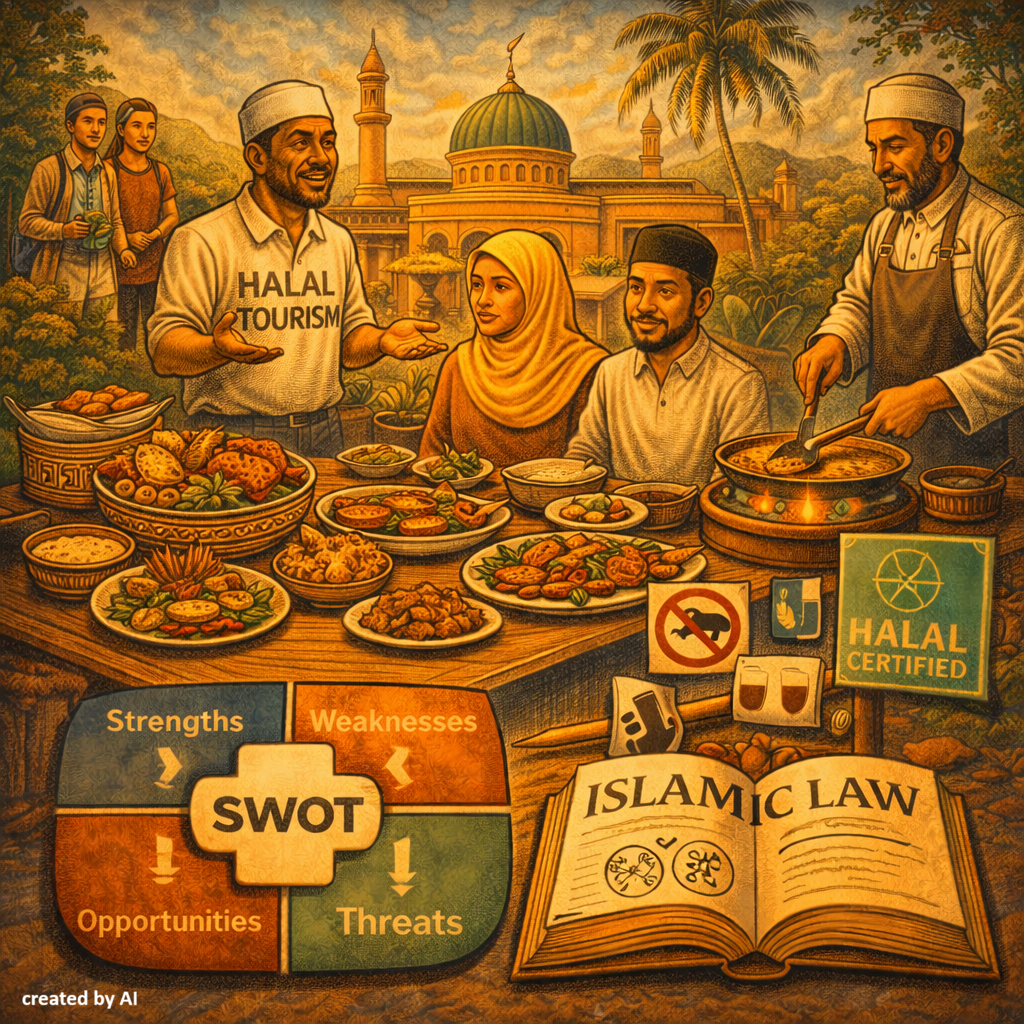
Purpose – This study aims to analyze the gap between the economic potential of traditional cuisine in the halal tourism ecosystem and the level of compliance of business actors with certification requirements, as stipulated in the Halal Product Guarantee Law. This study also examines the factors influencing the halal tourism ecosystem and halal guarantees among business actors in Laksa Tangerang.
Methods – This study used a qualitative descriptive method with a normative juridical approach. The analysis was conducted by linking the culinary practices of Laksa Tangerang with SWOT analysis and halal product assurance regulations in Indonesia. Data were obtained through observations in the culinary tourism area in Laksa Tangerang, interviews with Laksa vendors, visitors, and the local community, and relevant literature.
Findings – This study shows that the stagnation of halal culinary growth in Laksa Tangerang is caused by multidimensional structural constraints, including limited innovation, weak segmentation and promotion, and governance issues. The SWOT analysis identified several strategic strengths that position Laksa Tangerang as a potential hub for halal tourism development. From an Islamic law perspective, its integration into the halal tourism ecosystem requires formal halal certification as a Halal Product Guarantee, so that halal assurance is institutionalized in a credible manner. Therefore, strengthening halal literacy, expanding certification, and improving governance are prerequisites for transforming Laksa Tangerang into a competitive and sustainable halal culinary tourism destination.
Research contribution/limitations – This study contributes to providing space for the actualization of sharia values in local economic practices and offers a contextual and applicable SWOT analysis framework.
Originality/value – This research offers a new perspective on integrating traditional culinary heritage into the Islamic legal framework in a contextual manner, thereby offering a model for sustainable Halal tourism development.
Keywords
Article Details
Copyright (c) 2026 Abdul Rachman, Muhammad Azizan Fitriana, Hidayat, Risyda Nurul Qolbi, Bilaly Sangare

This work is licensed under a Creative Commons Attribution-ShareAlike 4.0 International License.
- Authors retain copyright and grant the journal right of first publication with the work simultaneously licensed under a Creative Commons Attribution License that allows others to share the work with an acknowledgement of the work's authorship and initial publication in this journal.
- Authors are able to enter into separate, additional contractual arrangements for the non-exclusive distribution of the journal's published version of the work (e.g., post it to an institutional repository or publish it in a book), with an acknowledgement of its initial publication in this journal.
- Authors are permitted and encouraged to post their work online (e.g., in institutional repositories or on their website) prior to and during the submission process, as it can lead to productive exchanges, as well as earlier and greater citation of published work.
References
- Abdul, A. R., and Khokhar, A. J. (2023). Role of Indonesian Council of Ulama in Halāl Certification and Product Guarantee. Journal of Islamic Thought and Civilization, 13(1), Article 1. https://journals.umt.edu.pk/index.php/JITC/article/view/2444
- Addina, F. N., Santoso, I., and Sucipto. (2020). Concept of halal food development to support halal tourism: A review. IOP Conference Series: Earth and Environmental Science, 475(1), 012053. https://doi.org/10.1088/1755-1315/475/1/012053
- Ardiansyah, I., and Silmi, N. F. (2022). STRATEGI PENGEMBANGAN DESTINASI WISATA KULINER DI KOTA TANGERANG DENGAN MATRIKS SWOT DAN ANALISIS QSPM (STUDI KASUS KAWASAN LAKSA TANGERANG). Jurnal Industri Pariwisata, 4(2), Article 2. https://doi.org/10.36441/pariwisata.v4i2.662
- Ayuningsih, S. F., Amelia, R., and Adi, A. (2025). Exploring Gastronomy Tourism: A Cultural and Culinary Journey through Pasar Lama Tangerang. Journal of Mandalika Review, 4(2), 79–87. https://doi.org/10.55701/mandalika.v4i2.322
- Blakely, E. J., and Leigh, N. G. (2010). Planning Local Economic Development: Theory and Practice. SAGE.
- BPJPH (@halal.indonesia) • Foto dan video Instagram. (2024, November 6). https://www.instagram.com/halal.indonesia/
- Chi, C. G.-Q., and Qu, H. (2008). Examining the structural relationships of destination image, tourist satisfaction and destination loyalty: An integrated approach. Tourism Management, 29(4), 624–636. https://doi.org/10.1016/j.tourman.2007.06.007
- Fauzi, M. A., Mohd Ali, N. S., Mat Russ, N., Mohamad, F., Battour, M., and Mohd Zaki, N. N. (2024). Halal certification in food products: Science mapping of present and future trends. Journal of Islamic Marketing, 15(12), 3564–3580. https://doi.org/10.1108/JIMA-12-2023-0407
- Fransiscus Xaverius Pudjo Wibowo and Yopie Chandra. (2025). Development of Creative Economy Based on Culinary Tourism in Pasar Lama Tangerang to Enhance Competitiveness and Sustainability. Vol. 6 No. 2 (2025). https://doi.org/10.47927/ijobit.v6i2.1358
- Giraldi Nando Herawan, -. (2023). POTENSI LAKSA SEBAGAI DAYA TARIK WISATA WARISAN GASTRONOMI DI KOTA TANGERANG (KAWASAN KULINER LAKSA TANGERANG [Other, Universitas Pendidikan Indonesia]. https://repository.upi.edu/
- Haddad, R., Harahsheh, S., and Harb, A. (2019). Halal food and Muslim tourists (pp. 451–461).
- Hall, C. M. (2000). Tourism Planning: Policies, Processes and Relationships. Prentice Hall.
- Hariani, D., Hanafiah, M. H., and Azwar, H. (2023). Systematic Literature Review: Indonesia Halal Tourism Priority Destinations. International Journal of Academic Research in Business and Social Sciences, 13(5). https://doi.org/10.6007/ijarbss/v13-i5/17052
- Heikal, M., Rachman, A., Muizzudin, and Falahuddin. (2024). Digitalization of Halal Food Supply Chain Management Based on Blockchain Technology. Springer Proceedings in Business and Economics, 103–121.
- Henderson, J. C. (2016). Halal food, certification and halal tourism: Insights from Malaysia and Singapore. Tourism Management Perspectives, 19, 160–164. https://doi.org/10.1016/j.tmp.2015.12.006
- Ilham, B. U., and As’ad, I. (2023). Development of a Halal Ecosystem in the Lego-Lego Makassar Culinary Tourism Area Based on KHAS Zones (Halal, Safe and Healthy Culinary). BOOK OF ABSTRACT INTERNATIONAL CONFERENCE ON HALAL, POLICY, CULTURE AND SUSTAINABILITY ISSUES, 5(1), Article 1.
- Kadri, K. (2022). Religion and Tourism: Promoting Inclusive Islam in Lombok Island, Indonesia. Studia Islamika, 29(2), Article 2. https://doi.org/10.36712/sdi.v29i2.14471
- Kemenag. (n.d.-a). Kemenag Dukung Inisiasi KNEKS Bentuk Zona Kuliner Halal. https://kemenag.go.id. Retrieved November 12, 2024, from https://kemenag.go.id/nasional/kemenag-dukung-inisiasi-kneks-bentuk-zona-kuliner-halal-dv28ef
- Kemenag. (n.d.-b). Makanan Halal Indonesia Ranking Dua Dunia, Kemenag: Kita Menuju Nomor Satu. https://kemenag.go.id. Retrieved November 12, 2024, from https://kemenag.go.id/pers-rilis/makanan-halal-indonesia-ranking-dua-dunia-kemenag-kita-menuju-nomor-satu-ex0lob
- Kemenag. (n.d.-c). Menag Launching Program 10 Juta Produk Bersertifikat Halal. https://www.kemenag.go.id. Retrieved September 3, 2023, from https://kemenag.go.id/pers-rilis/menag-launching-program-10-juta-produk-bersertifikat-halal-vy996c
- Komite Nasional Ekonomi dan Keuangan Syariah. (n.d.). Komite Nasional Ekonomi Dan Keuangan Syariah. Retrieved November 13, 2024, from https://kneks.go.id/satu-pusatdata
- Kotler, P., and Keller, K. L. (2012). Marketing Management (15th ed.). Prentice Hall.
- Laksa dan Cio Tao Jadi Warisan Tak Benda dari Kota Tangerang. (n.d.). Tangerangnews.Com. Retrieved November 12, 2024, from https://www.tangerangnews.com/kabupaten-tangerang/read/46686/Laksa-dan-Cio-Tao-Jadi-Warisan-Tak-Benda-dari-Kota-Tangerang
- Mohsin, A., Ramli, N., and Alkhulayfi, B. A. (2016). Halal tourism: Emerging opportunities. Tourism Management Perspectives, 19, 137–143. https://doi.org/10.1016/j.tmp.2015.12.010
- Nursal, M. F., and Fikri, A. W. N. (2019a). The business strategy of “Laksa” culinary tourism in Tangerang, Indonesia. Tourism and Leisure, 8.
- Nursal, M. F., and Fikri, A. W. N. (2019b). The business strategy of “Laksa” culinary tourism in Tangerang, Indonesia. Tourism and Leisure, 8.
- Potensi Pengembangan Wisata Halal di Indonesia. (n.d.). Retrieved November 9, 2024, from https://kemenparekraf.go.id/ragam-pariwisata/Potensi-Pengembangan-Wisata-Halal-di-Indonesia
- Pribadi, S., and Fitriana, D. (2023). Legal Security Regarding Labels and Certification of Halal Food Products Based on Law Number 33 of 2014 Concerning the Assuredness of Halal Products. Journal of Law, Politic and Humanities, 3(1), 236–240. https://doi.org/10.38035/jlph.v3i1.145
- Rachman, A. (2020). Halal Branding; A Religious Doctrine in the Development of Islamic Da’wah. Journal of Digital Marketing and Halal Industry, 2(2), Article 2. https://doi.org/10.21580/jdmhi.2020.2.2.6149
- Rachman, A., Faluthamia, M. A., Said, M., and Haura, A. (2022). The Urgency of Halal Tourism Literacy in Responding to Rejection of Halal Tourism in Indonesia. Afkaruna: Indonesian Interdisciplinary Journal of Islamic Studies, 18(1), Article 1. https://doi.org/10.18196/afkaruna.v18i1.12770
- Rachman, A., Maemunah, M., and Ulpah, M. (2022). DESAIN BARU LOGO HALAL BADAN PENYELENGGARA JAMINAN PRODUK HALAL; ANTARA URGENSI, SENI, DAN ESENSI. El-Buhuth: Borneo Journal of Islamic Studies, 245–262. https://doi.org/10.21093/el-buhuth.v0i0.4700
- Rachman, A., Muizzudin, Haura, A., and Simatupang, A. D. R. (2024). Potential for Development of Mosque-Based Halal Tourism in Lombok, West Nusa Tenggara Province. Journal of Islamic Economic and Business Research, 4(2), 176–189. https://doi.org/10.18196/jiebr.v4i2.319
- Rachman, A., and Sangare, B. (2023). SYNERGY AND COLLABORATION BETWEEN GOVERNMENT AND PRIVATE INSTITUTIONS IN BUILDING HALAL ECOSYSTEMS IN INDONESIA. Jurnal Ilmiah Islam Futura, 23(2), 303–303. https://doi.org/10.22373/jiif.v23i2.17507
- Ramadhani, M. (2021). DILEMA REGULASI PARIWISATA HALAL DI INDONESIA. Journal of Islamic Tourism Halal Food Islamic Traveling and Creative Economy, 1(1), 67–81. https://doi.org/10.21274/ar-rehla.2021.1.1.89-105
- riyanzoom. (n.d.). Post—Zona KHAS Pasar Lama Kota Serang. FK KIM Kota Serang. Retrieved November 12, 2024, from https://kim.serangkota.go.id//detailpost/zona-khas-pasar-lama-kota-serang
- Rokhman, W., and Abduh, M. (2019). Antecedents of SMEs’ satisfaction and loyalty towards Islamic microfinance: Evidence from Central Java, Indonesia. Journal of Islamic Marketing, 11(6), 1327–1338. https://doi.org/10.1108/JIMA-05-2018-0090
- Santoso, L., and Rachman, A. (2024). DIGITALISING HALAL CERTIFICATION: The Dynamic of Regulations and Policies Concerning Halal Certification in Indonesia. Jurisdictie: Jurnal Hukum Dan Syariah, 14(2), 265–293. https://doi.org/10.18860/j.v14i2.24115
- Savira, L., Nurhidayah, N., and Aprilliani, D. (2024). Analisis Faktor yang Mempengaruhi Kepuasan terhadap Kualitas Laksa Khas Tangerang. PERFECT EDUCATION FAIRY, 2(4), 186–191. https://doi.org/10.56442/pef.v2i4.1058
- State of the Global Islamic Economy Report 2022. (n.d.). Retrieved February 14, 2023, from https://www.dinarstandard.com/post/state-of-the-global-islamic-economy-report-2022
- Syahrizal, M. (2021). WISATA HALAL DI BANTEN: PERKEMBANGAN, PELUANG DAN TANTANGAN HALAL TOURISM IN BANTEN: DEVELOPMENT, OPPORTUNITY AND CHALLENGE. Dynamic Management Journal, 5(2), Article 2. https://doi.org/10.31000/dmj.v5i2.5638
- Tangerang, B. P. S. K. (n.d.). Kota Tangerang Dalam Angka 2024. Retrieved November 9, 2024, from https://tangerangkota.bps.go.id/id/publication/2024/02/28/55863c9902e4a38181e35a35/kota-tangerang-dalam-angka-2024.html
- Untari, D. T. U. T., and Satria, B. (2017). STRATEGI PENGEMBANGAN PEMASARAN “LAKSA TANGERANG” SEBAGAI SALAH SATU PRODUK WISATA KULINER DI TANGERANG. Business Management Journal, 10(2). https://doi.org/10.30813/bmj.v10i2.632
- Usman, H., Chairy, C., and Projo, N. W. K. (2021). Between awareness of halal food products and awareness of halal-certified food products. Journal of Islamic Marketing, 14(3), 851–870. https://doi.org/10.1108/JIMA-07-2021-0233
- Waluyo, B. S., Hufad, A., Hendrayana, A., and Leksono, S. M. (2022). POTENSI MAKANAN TRADISIONAL LAKSA SEBAGAI DAYA TARIK PARIWISATA DI KOTA TANGERANG. Home Economics Journal, 6(1), Article 1. https://doi.org/10.21831/hej.v6i1.41571
- Wibowo, A., Amar, M. Y., Mardiana, R., Sobarsyah, M., and Sabbar, S. D. (2024). Strategic planning for the development of a smart city in Tangerang, Indonesia: Integrating technology and innovation in urban development. Journal of Infrastructure, Policy and Development, 8(9), Article 9. https://doi.org/10.24294/jipd.v8i9.5885
- Wilson, A., Zeithaml, V. A., Bitner, M. J., and Gremler, D. D. (2018). Services Marketing: Integrating Customer Focus across the Firm. McGraw-Hill.
- Wilson, J. A. J. (2014). The halal phenomenon: An extension or a new paradigm? Social Business, 4(3), 255–271. https://doi.org/10.1362/204440814X14103454934294
- Wispandono, M., Utari, W., and Mardianan, R. (2023). STUDY ABOUT HALAL TOURISM DEVELOPMENT (CASE STUDY ON THE TOURISM INDUSTRY IN BANGKALAN, EAST JAVA). International Journal, 7(3).
- Zimmerman, M. (2012). Empowerment Theory. https://doi.org/10.1007/978-1-4615-4193-6_2
References
Abdul, A. R., and Khokhar, A. J. (2023). Role of Indonesian Council of Ulama in Halāl Certification and Product Guarantee. Journal of Islamic Thought and Civilization, 13(1), Article 1. https://journals.umt.edu.pk/index.php/JITC/article/view/2444
Addina, F. N., Santoso, I., and Sucipto. (2020). Concept of halal food development to support halal tourism: A review. IOP Conference Series: Earth and Environmental Science, 475(1), 012053. https://doi.org/10.1088/1755-1315/475/1/012053
Ardiansyah, I., and Silmi, N. F. (2022). STRATEGI PENGEMBANGAN DESTINASI WISATA KULINER DI KOTA TANGERANG DENGAN MATRIKS SWOT DAN ANALISIS QSPM (STUDI KASUS KAWASAN LAKSA TANGERANG). Jurnal Industri Pariwisata, 4(2), Article 2. https://doi.org/10.36441/pariwisata.v4i2.662
Ayuningsih, S. F., Amelia, R., and Adi, A. (2025). Exploring Gastronomy Tourism: A Cultural and Culinary Journey through Pasar Lama Tangerang. Journal of Mandalika Review, 4(2), 79–87. https://doi.org/10.55701/mandalika.v4i2.322
Blakely, E. J., and Leigh, N. G. (2010). Planning Local Economic Development: Theory and Practice. SAGE.
BPJPH (@halal.indonesia) • Foto dan video Instagram. (2024, November 6). https://www.instagram.com/halal.indonesia/
Chi, C. G.-Q., and Qu, H. (2008). Examining the structural relationships of destination image, tourist satisfaction and destination loyalty: An integrated approach. Tourism Management, 29(4), 624–636. https://doi.org/10.1016/j.tourman.2007.06.007
Fauzi, M. A., Mohd Ali, N. S., Mat Russ, N., Mohamad, F., Battour, M., and Mohd Zaki, N. N. (2024). Halal certification in food products: Science mapping of present and future trends. Journal of Islamic Marketing, 15(12), 3564–3580. https://doi.org/10.1108/JIMA-12-2023-0407
Fransiscus Xaverius Pudjo Wibowo and Yopie Chandra. (2025). Development of Creative Economy Based on Culinary Tourism in Pasar Lama Tangerang to Enhance Competitiveness and Sustainability. Vol. 6 No. 2 (2025). https://doi.org/10.47927/ijobit.v6i2.1358
Giraldi Nando Herawan, -. (2023). POTENSI LAKSA SEBAGAI DAYA TARIK WISATA WARISAN GASTRONOMI DI KOTA TANGERANG (KAWASAN KULINER LAKSA TANGERANG [Other, Universitas Pendidikan Indonesia]. https://repository.upi.edu/
Haddad, R., Harahsheh, S., and Harb, A. (2019). Halal food and Muslim tourists (pp. 451–461).
Hall, C. M. (2000). Tourism Planning: Policies, Processes and Relationships. Prentice Hall.
Hariani, D., Hanafiah, M. H., and Azwar, H. (2023). Systematic Literature Review: Indonesia Halal Tourism Priority Destinations. International Journal of Academic Research in Business and Social Sciences, 13(5). https://doi.org/10.6007/ijarbss/v13-i5/17052
Heikal, M., Rachman, A., Muizzudin, and Falahuddin. (2024). Digitalization of Halal Food Supply Chain Management Based on Blockchain Technology. Springer Proceedings in Business and Economics, 103–121.
Henderson, J. C. (2016). Halal food, certification and halal tourism: Insights from Malaysia and Singapore. Tourism Management Perspectives, 19, 160–164. https://doi.org/10.1016/j.tmp.2015.12.006
Ilham, B. U., and As’ad, I. (2023). Development of a Halal Ecosystem in the Lego-Lego Makassar Culinary Tourism Area Based on KHAS Zones (Halal, Safe and Healthy Culinary). BOOK OF ABSTRACT INTERNATIONAL CONFERENCE ON HALAL, POLICY, CULTURE AND SUSTAINABILITY ISSUES, 5(1), Article 1.
Kadri, K. (2022). Religion and Tourism: Promoting Inclusive Islam in Lombok Island, Indonesia. Studia Islamika, 29(2), Article 2. https://doi.org/10.36712/sdi.v29i2.14471
Kemenag. (n.d.-a). Kemenag Dukung Inisiasi KNEKS Bentuk Zona Kuliner Halal. https://kemenag.go.id. Retrieved November 12, 2024, from https://kemenag.go.id/nasional/kemenag-dukung-inisiasi-kneks-bentuk-zona-kuliner-halal-dv28ef
Kemenag. (n.d.-b). Makanan Halal Indonesia Ranking Dua Dunia, Kemenag: Kita Menuju Nomor Satu. https://kemenag.go.id. Retrieved November 12, 2024, from https://kemenag.go.id/pers-rilis/makanan-halal-indonesia-ranking-dua-dunia-kemenag-kita-menuju-nomor-satu-ex0lob
Kemenag. (n.d.-c). Menag Launching Program 10 Juta Produk Bersertifikat Halal. https://www.kemenag.go.id. Retrieved September 3, 2023, from https://kemenag.go.id/pers-rilis/menag-launching-program-10-juta-produk-bersertifikat-halal-vy996c
Komite Nasional Ekonomi dan Keuangan Syariah. (n.d.). Komite Nasional Ekonomi Dan Keuangan Syariah. Retrieved November 13, 2024, from https://kneks.go.id/satu-pusatdata
Kotler, P., and Keller, K. L. (2012). Marketing Management (15th ed.). Prentice Hall.
Laksa dan Cio Tao Jadi Warisan Tak Benda dari Kota Tangerang. (n.d.). Tangerangnews.Com. Retrieved November 12, 2024, from https://www.tangerangnews.com/kabupaten-tangerang/read/46686/Laksa-dan-Cio-Tao-Jadi-Warisan-Tak-Benda-dari-Kota-Tangerang
Mohsin, A., Ramli, N., and Alkhulayfi, B. A. (2016). Halal tourism: Emerging opportunities. Tourism Management Perspectives, 19, 137–143. https://doi.org/10.1016/j.tmp.2015.12.010
Nursal, M. F., and Fikri, A. W. N. (2019a). The business strategy of “Laksa” culinary tourism in Tangerang, Indonesia. Tourism and Leisure, 8.
Nursal, M. F., and Fikri, A. W. N. (2019b). The business strategy of “Laksa” culinary tourism in Tangerang, Indonesia. Tourism and Leisure, 8.
Potensi Pengembangan Wisata Halal di Indonesia. (n.d.). Retrieved November 9, 2024, from https://kemenparekraf.go.id/ragam-pariwisata/Potensi-Pengembangan-Wisata-Halal-di-Indonesia
Pribadi, S., and Fitriana, D. (2023). Legal Security Regarding Labels and Certification of Halal Food Products Based on Law Number 33 of 2014 Concerning the Assuredness of Halal Products. Journal of Law, Politic and Humanities, 3(1), 236–240. https://doi.org/10.38035/jlph.v3i1.145
Rachman, A. (2020). Halal Branding; A Religious Doctrine in the Development of Islamic Da’wah. Journal of Digital Marketing and Halal Industry, 2(2), Article 2. https://doi.org/10.21580/jdmhi.2020.2.2.6149
Rachman, A., Faluthamia, M. A., Said, M., and Haura, A. (2022). The Urgency of Halal Tourism Literacy in Responding to Rejection of Halal Tourism in Indonesia. Afkaruna: Indonesian Interdisciplinary Journal of Islamic Studies, 18(1), Article 1. https://doi.org/10.18196/afkaruna.v18i1.12770
Rachman, A., Maemunah, M., and Ulpah, M. (2022). DESAIN BARU LOGO HALAL BADAN PENYELENGGARA JAMINAN PRODUK HALAL; ANTARA URGENSI, SENI, DAN ESENSI. El-Buhuth: Borneo Journal of Islamic Studies, 245–262. https://doi.org/10.21093/el-buhuth.v0i0.4700
Rachman, A., Muizzudin, Haura, A., and Simatupang, A. D. R. (2024). Potential for Development of Mosque-Based Halal Tourism in Lombok, West Nusa Tenggara Province. Journal of Islamic Economic and Business Research, 4(2), 176–189. https://doi.org/10.18196/jiebr.v4i2.319
Rachman, A., and Sangare, B. (2023). SYNERGY AND COLLABORATION BETWEEN GOVERNMENT AND PRIVATE INSTITUTIONS IN BUILDING HALAL ECOSYSTEMS IN INDONESIA. Jurnal Ilmiah Islam Futura, 23(2), 303–303. https://doi.org/10.22373/jiif.v23i2.17507
Ramadhani, M. (2021). DILEMA REGULASI PARIWISATA HALAL DI INDONESIA. Journal of Islamic Tourism Halal Food Islamic Traveling and Creative Economy, 1(1), 67–81. https://doi.org/10.21274/ar-rehla.2021.1.1.89-105
riyanzoom. (n.d.). Post—Zona KHAS Pasar Lama Kota Serang. FK KIM Kota Serang. Retrieved November 12, 2024, from https://kim.serangkota.go.id//detailpost/zona-khas-pasar-lama-kota-serang
Rokhman, W., and Abduh, M. (2019). Antecedents of SMEs’ satisfaction and loyalty towards Islamic microfinance: Evidence from Central Java, Indonesia. Journal of Islamic Marketing, 11(6), 1327–1338. https://doi.org/10.1108/JIMA-05-2018-0090
Santoso, L., and Rachman, A. (2024). DIGITALISING HALAL CERTIFICATION: The Dynamic of Regulations and Policies Concerning Halal Certification in Indonesia. Jurisdictie: Jurnal Hukum Dan Syariah, 14(2), 265–293. https://doi.org/10.18860/j.v14i2.24115
Savira, L., Nurhidayah, N., and Aprilliani, D. (2024). Analisis Faktor yang Mempengaruhi Kepuasan terhadap Kualitas Laksa Khas Tangerang. PERFECT EDUCATION FAIRY, 2(4), 186–191. https://doi.org/10.56442/pef.v2i4.1058
State of the Global Islamic Economy Report 2022. (n.d.). Retrieved February 14, 2023, from https://www.dinarstandard.com/post/state-of-the-global-islamic-economy-report-2022
Syahrizal, M. (2021). WISATA HALAL DI BANTEN: PERKEMBANGAN, PELUANG DAN TANTANGAN HALAL TOURISM IN BANTEN: DEVELOPMENT, OPPORTUNITY AND CHALLENGE. Dynamic Management Journal, 5(2), Article 2. https://doi.org/10.31000/dmj.v5i2.5638
Tangerang, B. P. S. K. (n.d.). Kota Tangerang Dalam Angka 2024. Retrieved November 9, 2024, from https://tangerangkota.bps.go.id/id/publication/2024/02/28/55863c9902e4a38181e35a35/kota-tangerang-dalam-angka-2024.html
Untari, D. T. U. T., and Satria, B. (2017). STRATEGI PENGEMBANGAN PEMASARAN “LAKSA TANGERANG” SEBAGAI SALAH SATU PRODUK WISATA KULINER DI TANGERANG. Business Management Journal, 10(2). https://doi.org/10.30813/bmj.v10i2.632
Usman, H., Chairy, C., and Projo, N. W. K. (2021). Between awareness of halal food products and awareness of halal-certified food products. Journal of Islamic Marketing, 14(3), 851–870. https://doi.org/10.1108/JIMA-07-2021-0233
Waluyo, B. S., Hufad, A., Hendrayana, A., and Leksono, S. M. (2022). POTENSI MAKANAN TRADISIONAL LAKSA SEBAGAI DAYA TARIK PARIWISATA DI KOTA TANGERANG. Home Economics Journal, 6(1), Article 1. https://doi.org/10.21831/hej.v6i1.41571
Wibowo, A., Amar, M. Y., Mardiana, R., Sobarsyah, M., and Sabbar, S. D. (2024). Strategic planning for the development of a smart city in Tangerang, Indonesia: Integrating technology and innovation in urban development. Journal of Infrastructure, Policy and Development, 8(9), Article 9. https://doi.org/10.24294/jipd.v8i9.5885
Wilson, A., Zeithaml, V. A., Bitner, M. J., and Gremler, D. D. (2018). Services Marketing: Integrating Customer Focus across the Firm. McGraw-Hill.
Wilson, J. A. J. (2014). The halal phenomenon: An extension or a new paradigm? Social Business, 4(3), 255–271. https://doi.org/10.1362/204440814X14103454934294
Wispandono, M., Utari, W., and Mardianan, R. (2023). STUDY ABOUT HALAL TOURISM DEVELOPMENT (CASE STUDY ON THE TOURISM INDUSTRY IN BANGKALAN, EAST JAVA). International Journal, 7(3).
Zimmerman, M. (2012). Empowerment Theory. https://doi.org/10.1007/978-1-4615-4193-6_2