
Article Sidebar
Main Article Content
Abstract
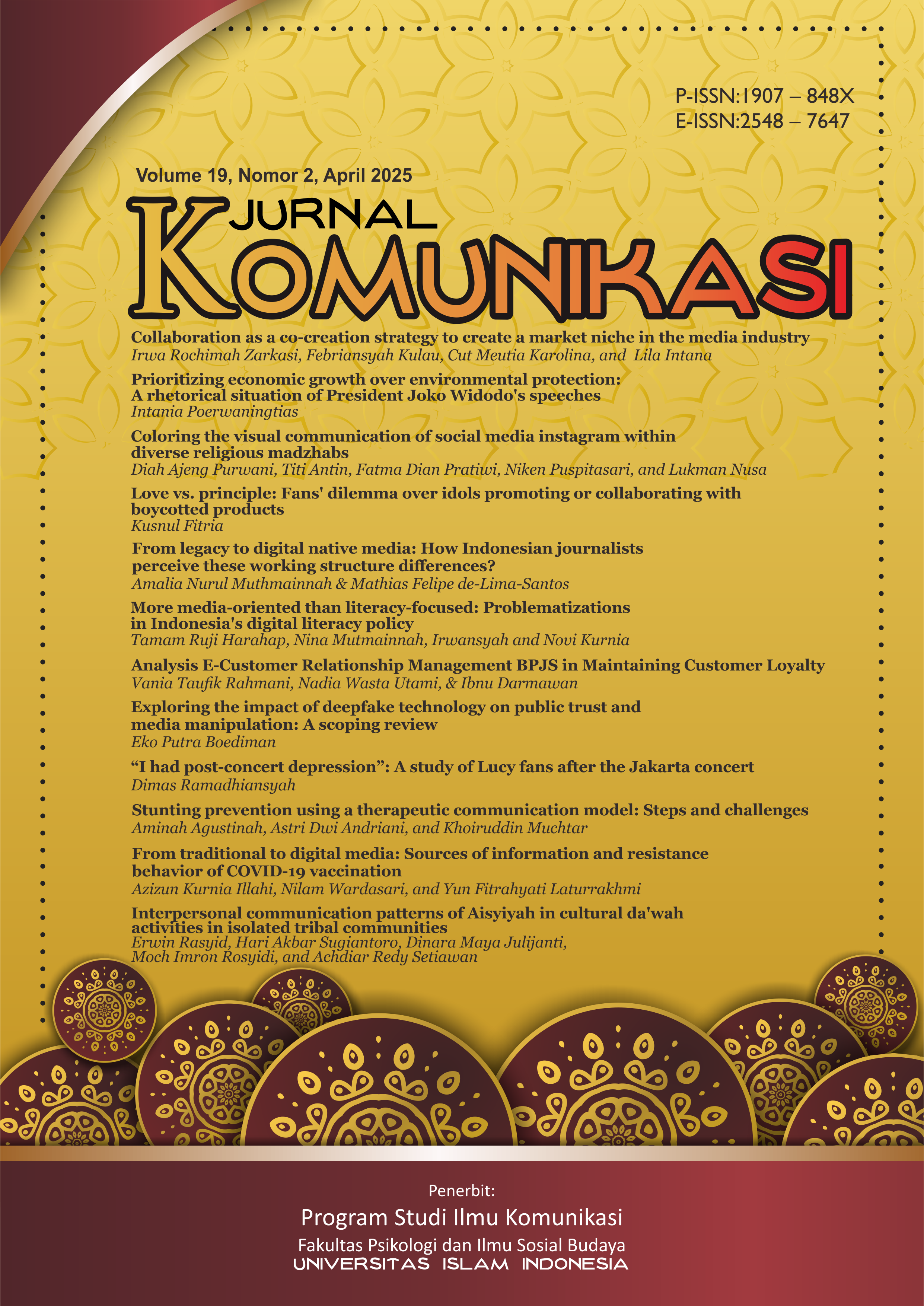
This study explores the attitudes of K-pop fans when faced with the dilemma of their idols collaborating with boycotted products. The research was conducted qualitatively by combining digital ethnography and audiovisual analysis methods. Data were collected through observations of K-pop fans' activities on TikTok and Twitter (X). The findings reveal that K-pop fans display three main attitudes in response to their idols' collaboration with boycotted products. The first attitude is to continue to be a fan and support the idol. However, this support is expressed through various reasons and actions, such as making donations that reflect conditional loyalty and ambiguous participation. The second attitude is active rejection, carried out through participation in cancel culture. This is expressed by unfollowing the idol's social media accounts and deleting fan pages. The third attitude is leaving the fandom and becoming a haters. Although not all fans who leave the fandom become haters, feelings of disappointment and betrayal by the idol are the main reasons behind this response.
Keywords
Article Details
Copyright (c) 2025 Kusnul Fitria

This work is licensed under a Creative Commons Attribution-ShareAlike 4.0 International License.
Authors who publish with this journal agree to the following terms:
- Authors retain copyright and grant the journal right of first publication with the work simultaneously licensed under a Creative Commons Attribution License that allows others to share the work with an acknowledgement of the work's authorship and initial publication in this journal.
- Authors are able to enter into separate, additional contractual arrangements for the non-exclusive distribution of the journal's published version of the work (e.g., post it to an institutional repository or publish it in a book), with an acknowledgement of its initial publication in this journal.
- Authors are permitted and encouraged to post their work online (e.g., in institutional repositories or on their website) prior to and during the submission process, as it can lead to productive exchanges, as well as earlier and greater citation of published work (See The Effect of Open Access).



References
- Abidin, C., & Kaye, B. V. (2021). Audio memes, earworms, and templatability: The ‘aural turn’ of memes on TikTok. In C. Arkenbout, J. Wilson, & D. de Zeeuw (Eds.), Critical Meme Reader: Global Mutations of the Viral Image (pp. 58–68). the Institute of Network Cultures.
- Ackermann, K., & Gundelach, B. (2020). Psychological roots of political consumerism: Personality traits and participation in boycott and buycott. International Political Science Review, 43(1), 36–54. https://doi.org/10.1177/0192512120959683
- Bell, P., Staines, P., & Michell, J. (2001). Evaluating, doing and writing research in psychology. SAGE Publications Ltd. https://doi.org/10.4135/9781849209106
- Buheji, M., & Ahmed, D. (2023). Keeping the boycott momentum- from ‘war on Gaza’ till ‘Free-Palestine.’ International Journal of Management (IJM), 14(7), 205–229. https://doi.org/10.17605/OSF.IO/NC75D
- Chang, T.-T., & Lim, J. (2002). Cross-cultural communication and social presence in asynchronous learning processes. E-Service Journal, 1(3), 83–105. https://doi.org/10.2979/esj.2002.1.3.83
- Duffett, M. (2013). Understanding fandom an introduction to the study of media fan culture. Bloomsbury Publishing Plc.
- Fiske, J. (1992). The cultural economy of fandom. In The Adoring Audience. Routledge.
- Fitria, K. (2022a). Sebuah kajian ethnografi digital pada keterlibatan fandom K-pop dengan isu sosial di media sosial. Jurnal Muara Ilmu Sosial, Humaniora, Dan Seni, 6(2), 258–469. https://doi.org/https://doi.org/10.24912/
- Fitria, K. (2022b). Cyberspace sebagai area perang antara fans versus haters K-pop di Instagram. Jurnal Kopis: Kajian Penelitian Dan Pemikiran Komunikasi Penyiaran Islam, 4, 58–73. https://doi.org/10.33367/kpi.v4i2.1945
- Gray, J. (2003). New audiences, new textualities: Anti-fans and non-fans. International Journal of Cultural Studies, 6(1), 64–81. https://doi.org/10.1177/1367877903006001004
- Hills, M. (2002). Fan cultures. Routledge. https://books.google.co.id/books?id=td10zMpqK4gC
- Hine, C. (2017). Digital ethnography. In The Wiley‐Blackwell Encyclopedia of Social Theory (pp. 1–2). https://doi.org/https://doi.org/10.1002/9781118430873.est0628
- Hsu, C.-F. (2007). A cross-cultural comparison of communication orientations between Americans and Taiwanese. Communication Quarterly, 55(3), 359–374. https://doi.org/10.1080/01463370701497831
- Huang, X. (2012). Lifestyles in virtual communities: Collaborative consumption and interaction. Chinese Journal of Communication, 5(1), 109–127. https://doi.org/10.1080/17544750.2011.640542
- Ibtisamah Laila, Mira Mariani, Rakhmah Fakhriani, & Rinjania Rinjania. (2024). Analisis dampak sosial Boikot produk pro-Israel. Moral : Jurnal Kajian Pendidikan Islam, 1(4 SE-Articles), 324–330. https://doi.org/10.61132/moral.v1i4.436
- Jenkins, H. (1992). Textual poachers: Television fans & participatory Culture. Routledge. https://books.google.co.id/books?id=6OsLngEACAAJ
- Jenkins, H. (2006a). Convergence culture: Where old and new media collide. New York University Press.
- Jenkins, H. (2006b). Fans, bloggers, and gamers: Exploring participatory culture. https://doi.org/10.18574/nyu/9780814743690.001.0001
- Jumiati, S., Dodi Vionanda, & Admi Salma. (2024). How MUI fatwa changes indonesia mindset towards pro-Israel boycott products using the naïve bayes classification method. UNP Journal of Statistics and Data Science, 2(4 SE-Articles), 495–501. https://doi.org/10.24036/ujsds/vol2-iss4/326
- KCN, A. (2024). Usai posting foto kentang McD, pengikut V BTS di Instagram turun segini, standar ganda? Netizen bereaksi! Kpopchart.Net.
- Kim, S.-Y. (2018). K-pop live: Fans, idols, and multimedia performance. Stanford University Press.
- Kułaga, W. (2024). Revolutionizing visual communication and digital creative engagement: The game-changing impact of tiktok. Przeglad Socjologii Jakosciowej, 20(3), 212–235. https://doi.org/10.18778/1733-8069.20.3.10
- Kurniawan, R. S., Juhari, Zufriady, & Holanda, S. (2024). Efektivitas seruan aksi boikot produk pro Israel terhadap keputusan pembelian dan dampaknya bagi produk lokal. Jurnal Valuasi: Jurnal Ilmiah Ilmu Manajemen Dan Kewirausahaan, 4(2).
- Lee, W., & Kao, G. Y. (2021). “Make it right”: Why #BlackLivesMatter(s) to K-pop, BTS, and BTS ARMYs. IASPM Journal. https://api.semanticscholar.org/CorpusID:244593575
- Liao, S., & Xia, G. (2022). Consumer nationalism in digital space: A case study of the 2017 anti-lotte boycott in China. Convergence, 29(6), 1535–1554. https://doi.org/10.1177/13548565221090198
- Maleewong, K. (2016). An analysis of influential users for predicting the popularity of news tweets. Lecture Notes in Computer Science (Including Subseries Lecture Notes in Artificial Intelligence and Lecture Notes in Bioinformatics), 9810 LNCS, 306–318. https://doi.org/10.1007/978-3-319-42911-3_26
- Ng, E. (2022). Cancel Culture: A critical analysis (1st ed.). Springer International Publishing. https://books.google.co.id/books?id=Sxi3zwEACAAJ
- Oliveira, N., Costa, J., Silva, C., & Ribeiro, B. (2020). Retweet predictive model for predicting the popularity of tweets. Advances in Intelligent Systems and Computing, 942, 185–193. https://doi.org/10.1007/978-3-030-17065-3_19
- Pacheco, M. S., & Conrado Moreira da Silva, J. M. (2022). Donald Trump X hallyu: o ativismo dos fãs de K-pop nas redes sociais : K-Pop fan activism on social media. Revista Trama Interdisciplinar, 13(1 SE-Artigos), 195–207. https://editorarevistas.mackenzie.br/index.php/tint/article/view/14848
- Salas, J., Shanahan, D., & Gonzalez, G. (2019). Strategies for managing in the age of boycotts. Graziadio Business Report, 22(3), 1–6.
- Saldanha, N., Mulye, R., & Rahman, K. (2023). Cancel culture and the consumer: A strategic marketing perspective. Journal of Strategic Marketing, 31(5), 1071–1086. https://doi.org/10.1080/0965254X.2022.2040577
- Sandvoss, C. (2005). Fans: The mirror of consumption. Polity Press.
- Sen, S., Gürhan‐Canli, Z., & Morwitz, V. (2001). Withholding consumption: A social dilemma perspective on consumer boycotts. Journal of Consumer Research, 28(3), 399–417. https://doi.org/10.1086/323729
- Tilly, C. (2004). Social movements, 1768-2004. Paradigm Publishers. https://books.google.co.id/books?id=TentAAAAMAAJ
- Zayyadi, A., & Ubaidillah. (2024). Boycott in the perspective of the quran: Interpretation of rejecting actions that reflect justice and unity of The Ummah. AL-WIJDÁN: Journal of Islamic Education Studies., 6(436–457). https://doi.org/doi: 10.58788/alwijdn.v9i3.4891
References
Abidin, C., & Kaye, B. V. (2021). Audio memes, earworms, and templatability: The ‘aural turn’ of memes on TikTok. In C. Arkenbout, J. Wilson, & D. de Zeeuw (Eds.), Critical Meme Reader: Global Mutations of the Viral Image (pp. 58–68). the Institute of Network Cultures.
Ackermann, K., & Gundelach, B. (2020). Psychological roots of political consumerism: Personality traits and participation in boycott and buycott. International Political Science Review, 43(1), 36–54. https://doi.org/10.1177/0192512120959683
Bell, P., Staines, P., & Michell, J. (2001). Evaluating, doing and writing research in psychology. SAGE Publications Ltd. https://doi.org/10.4135/9781849209106
Buheji, M., & Ahmed, D. (2023). Keeping the boycott momentum- from ‘war on Gaza’ till ‘Free-Palestine.’ International Journal of Management (IJM), 14(7), 205–229. https://doi.org/10.17605/OSF.IO/NC75D
Chang, T.-T., & Lim, J. (2002). Cross-cultural communication and social presence in asynchronous learning processes. E-Service Journal, 1(3), 83–105. https://doi.org/10.2979/esj.2002.1.3.83
Duffett, M. (2013). Understanding fandom an introduction to the study of media fan culture. Bloomsbury Publishing Plc.
Fiske, J. (1992). The cultural economy of fandom. In The Adoring Audience. Routledge.
Fitria, K. (2022a). Sebuah kajian ethnografi digital pada keterlibatan fandom K-pop dengan isu sosial di media sosial. Jurnal Muara Ilmu Sosial, Humaniora, Dan Seni, 6(2), 258–469. https://doi.org/https://doi.org/10.24912/
Fitria, K. (2022b). Cyberspace sebagai area perang antara fans versus haters K-pop di Instagram. Jurnal Kopis: Kajian Penelitian Dan Pemikiran Komunikasi Penyiaran Islam, 4, 58–73. https://doi.org/10.33367/kpi.v4i2.1945
Gray, J. (2003). New audiences, new textualities: Anti-fans and non-fans. International Journal of Cultural Studies, 6(1), 64–81. https://doi.org/10.1177/1367877903006001004
Hills, M. (2002). Fan cultures. Routledge. https://books.google.co.id/books?id=td10zMpqK4gC
Hine, C. (2017). Digital ethnography. In The Wiley‐Blackwell Encyclopedia of Social Theory (pp. 1–2). https://doi.org/https://doi.org/10.1002/9781118430873.est0628
Hsu, C.-F. (2007). A cross-cultural comparison of communication orientations between Americans and Taiwanese. Communication Quarterly, 55(3), 359–374. https://doi.org/10.1080/01463370701497831
Huang, X. (2012). Lifestyles in virtual communities: Collaborative consumption and interaction. Chinese Journal of Communication, 5(1), 109–127. https://doi.org/10.1080/17544750.2011.640542
Ibtisamah Laila, Mira Mariani, Rakhmah Fakhriani, & Rinjania Rinjania. (2024). Analisis dampak sosial Boikot produk pro-Israel. Moral : Jurnal Kajian Pendidikan Islam, 1(4 SE-Articles), 324–330. https://doi.org/10.61132/moral.v1i4.436
Jenkins, H. (1992). Textual poachers: Television fans & participatory Culture. Routledge. https://books.google.co.id/books?id=6OsLngEACAAJ
Jenkins, H. (2006a). Convergence culture: Where old and new media collide. New York University Press.
Jenkins, H. (2006b). Fans, bloggers, and gamers: Exploring participatory culture. https://doi.org/10.18574/nyu/9780814743690.001.0001
Jumiati, S., Dodi Vionanda, & Admi Salma. (2024). How MUI fatwa changes indonesia mindset towards pro-Israel boycott products using the naïve bayes classification method. UNP Journal of Statistics and Data Science, 2(4 SE-Articles), 495–501. https://doi.org/10.24036/ujsds/vol2-iss4/326
KCN, A. (2024). Usai posting foto kentang McD, pengikut V BTS di Instagram turun segini, standar ganda? Netizen bereaksi! Kpopchart.Net.
Kim, S.-Y. (2018). K-pop live: Fans, idols, and multimedia performance. Stanford University Press.
Kułaga, W. (2024). Revolutionizing visual communication and digital creative engagement: The game-changing impact of tiktok. Przeglad Socjologii Jakosciowej, 20(3), 212–235. https://doi.org/10.18778/1733-8069.20.3.10
Kurniawan, R. S., Juhari, Zufriady, & Holanda, S. (2024). Efektivitas seruan aksi boikot produk pro Israel terhadap keputusan pembelian dan dampaknya bagi produk lokal. Jurnal Valuasi: Jurnal Ilmiah Ilmu Manajemen Dan Kewirausahaan, 4(2).
Lee, W., & Kao, G. Y. (2021). “Make it right”: Why #BlackLivesMatter(s) to K-pop, BTS, and BTS ARMYs. IASPM Journal. https://api.semanticscholar.org/CorpusID:244593575
Liao, S., & Xia, G. (2022). Consumer nationalism in digital space: A case study of the 2017 anti-lotte boycott in China. Convergence, 29(6), 1535–1554. https://doi.org/10.1177/13548565221090198
Maleewong, K. (2016). An analysis of influential users for predicting the popularity of news tweets. Lecture Notes in Computer Science (Including Subseries Lecture Notes in Artificial Intelligence and Lecture Notes in Bioinformatics), 9810 LNCS, 306–318. https://doi.org/10.1007/978-3-319-42911-3_26
Ng, E. (2022). Cancel Culture: A critical analysis (1st ed.). Springer International Publishing. https://books.google.co.id/books?id=Sxi3zwEACAAJ
Oliveira, N., Costa, J., Silva, C., & Ribeiro, B. (2020). Retweet predictive model for predicting the popularity of tweets. Advances in Intelligent Systems and Computing, 942, 185–193. https://doi.org/10.1007/978-3-030-17065-3_19
Pacheco, M. S., & Conrado Moreira da Silva, J. M. (2022). Donald Trump X hallyu: o ativismo dos fãs de K-pop nas redes sociais : K-Pop fan activism on social media. Revista Trama Interdisciplinar, 13(1 SE-Artigos), 195–207. https://editorarevistas.mackenzie.br/index.php/tint/article/view/14848
Salas, J., Shanahan, D., & Gonzalez, G. (2019). Strategies for managing in the age of boycotts. Graziadio Business Report, 22(3), 1–6.
Saldanha, N., Mulye, R., & Rahman, K. (2023). Cancel culture and the consumer: A strategic marketing perspective. Journal of Strategic Marketing, 31(5), 1071–1086. https://doi.org/10.1080/0965254X.2022.2040577
Sandvoss, C. (2005). Fans: The mirror of consumption. Polity Press.
Sen, S., Gürhan‐Canli, Z., & Morwitz, V. (2001). Withholding consumption: A social dilemma perspective on consumer boycotts. Journal of Consumer Research, 28(3), 399–417. https://doi.org/10.1086/323729
Tilly, C. (2004). Social movements, 1768-2004. Paradigm Publishers. https://books.google.co.id/books?id=TentAAAAMAAJ
Zayyadi, A., & Ubaidillah. (2024). Boycott in the perspective of the quran: Interpretation of rejecting actions that reflect justice and unity of The Ummah. AL-WIJDÁN: Journal of Islamic Education Studies., 6(436–457). https://doi.org/doi: 10.58788/alwijdn.v9i3.4891