
Article Sidebar
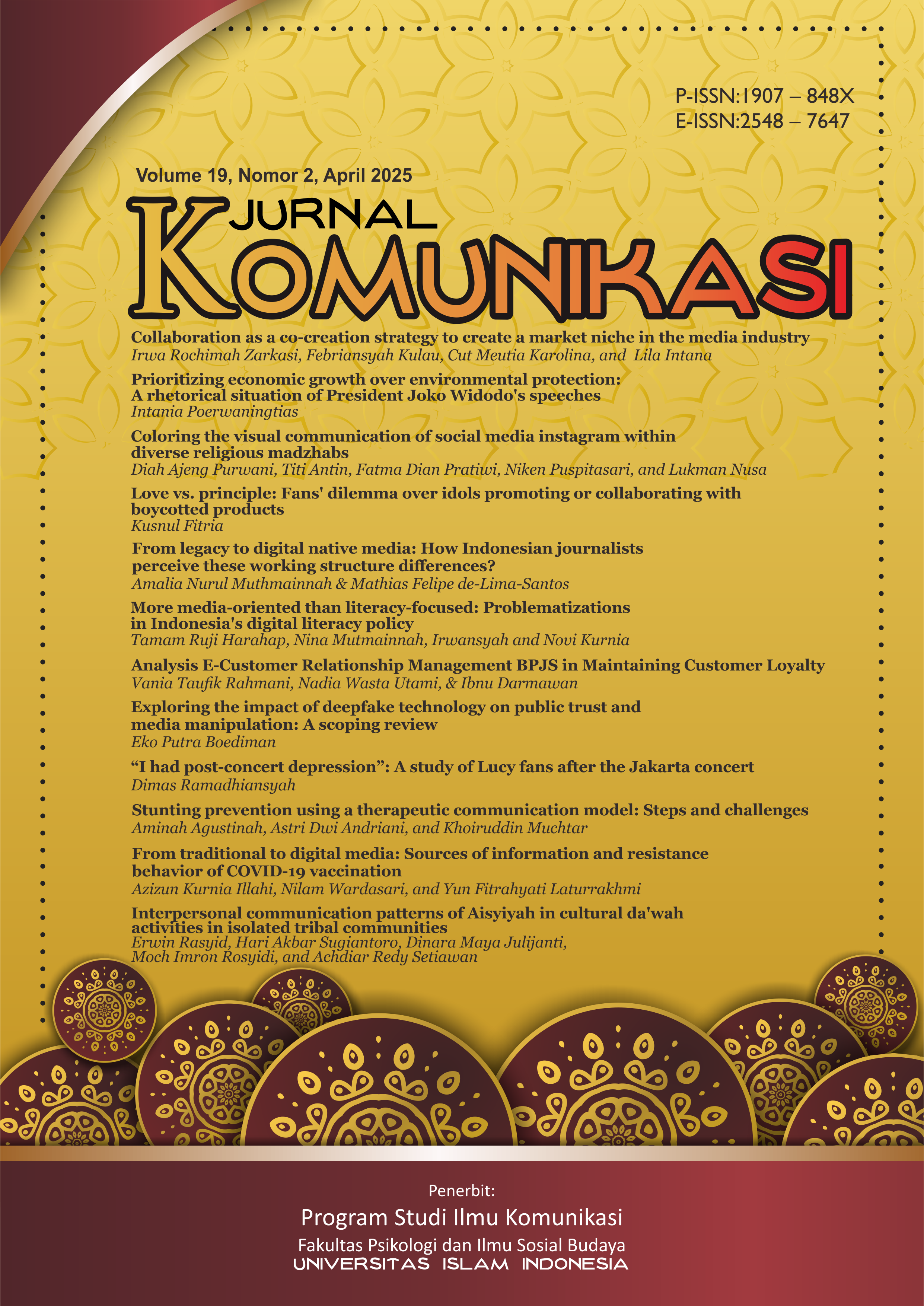
Main Article Content
Abstract
This study examines the impact of Hallyu, particularly K-pop, on fan communities in Indonesia, focusing on the phenomenon of Post-Concert Depression (PCD) often experienced by fans after major concerts. Using the netnography method, the study observes the interaction dynamics within a WhatsApp group of LUCY fans following the "We Are Landing in Jakarta" concert in January 2024. Findings show that social support within online communities helps alleviate PCD by sharing concert memories, photos, and emotional reflections. The group’s activities evolved from concert discussions to other topics like artist news and fan events, creating a dynamic communication space. Over time, relationships within the group became more personal, transforming it into a digital family grounded in empathy. Digital communities like "Kepulauan LUCY" demonstrate the potential to build strong emotional bonds online.
Keywords
Article Details
Copyright (c) 2025 Dimas Ramadhiansyah

This work is licensed under a Creative Commons Attribution-ShareAlike 4.0 International License.
Authors who publish with this journal agree to the following terms:
- Authors retain copyright and grant the journal right of first publication with the work simultaneously licensed under a Creative Commons Attribution License that allows others to share the work with an acknowledgement of the work's authorship and initial publication in this journal.
- Authors are able to enter into separate, additional contractual arrangements for the non-exclusive distribution of the journal's published version of the work (e.g., post it to an institutional repository or publish it in a book), with an acknowledgement of its initial publication in this journal.
- Authors are permitted and encouraged to post their work online (e.g., in institutional repositories or on their website) prior to and during the submission process, as it can lead to productive exchanges, as well as earlier and greater citation of published work (See The Effect of Open Access).




References
- Amelia, L. T. D., & Balqis, N. R. (2023). Changes in Communication Patterns in the Digital Age. ARRUS Journal of Social Sciences and Humanities, 3(4), 544–556. https://doi.org/10.35877/soshum1992
- Bargh, J. A., & McKenna, K. Y. A. (2004). The Internet and social life. Annual Review of Psychology, 55, 573–590. https://doi.org/10.1146/annurev.psych.55.090902.141922
- Baym, N. K. (2018). Playing to the Crowd Musicians, Audiences, and the Intimate Work of Connection. NYU Press.
- Björklöf, T. (2023). Audience engagement in K-pop concerts. Haaga-Helia University of Applied Sciences.
- Boyd, D. M., & Ellison, N. B. (2007). Social network sites: Definition, history, and scholarship. Journal of Computer-Mediated Communication, 13(1), 210–230. https://doi.org/10.1111/j.1083-6101.2007.00393.x
- Brown, S. C., & Knox, D. (2017). Why go to pop concerts? The motivations behind live music attendance. Musicae Scientiae, 21(3), 233–249. https://doi.org/10.1177/1029864916650719
- Dewi, W. P., & Puspita, W. D. (2024). A Descriptive Study on Attitudes toward Seeking Professional Psychological Help among Emerging Adults in a K-pop Fan Community. 5(1), 41–55.
- Dieleman, N. (2022). The effects of the K-pop group BTS on the mental health and well-being of their fans , a qualitative study. 2021–2022.
- Dyandra Global. (2023). SMTOWN Live 2023: SMCU Palace Jakarta with KB Bank. Retrieved from https://dyandraglobal.com/id/event/smtown-live-2023-smcu-palace-jakarta-with-kb-bank-2/
- England, A & Boland, M (2023, September 7). Post-Concert Depression is Real — Here’s Why It Happens. Healthline. https://www-healthline-com.translate.goog/health/post-concert-depression?_x_tr_sl=en&_x_tr_tl=id&_x_tr_hl=id&_x_tr_pto=tc
- Fancourt, D., Ockelford, A., & Belai, A. (2014). The psychoneuroimmunological effects of music: A systematic review and a new model. Brain, Behavior, and Immunity, 36, 15–26. https://doi.org/10.1016/j.bbi.2013.10.014
- Fleiss, A. (2024, June 26). Post-Concert Depression : Understanding the Phenomenon and Why NYC is Highly Susceptible. Rebellion Research. https://www.rebellionresearch.com/post-concert-depression-understanding-the-phenomenon-and-why-nyc-is-highly-susceptible
- Hampton, K. N., & Wellman, B. (2018). Lost and Saved.. Again: The Moral Panic about the Loss of Community Takes Hold of Social Media. Contemporary Sociology, 47(6), 643–651. https://doi.org/10.1177/0094306118805415
- Haulenbeek, S. K. (2022). Mental Health, Community, Commitment, and the Growth of Individual Identity in the Participatory Fandom of the BTS ARMY. Journal: ODU Undergraduate Research Journal OUR Journal: ODU Undergraduate Research Journal, 9, 5. https://doi.org/10.25778/rd1r-ep02
- Ismail, U., & Khan, M. (2023). K-pop Fans Practices: Content Consumption to Participatory Approach. Global Digital & Print Media Review, VI(II), 238–250. https://doi.org/10.31703/gdpmr.2023(vi-ii).16
- Jeong, J. S., Lee, S. H., & Lee, S. G. (2017). When Indonesians routinely consume Korean pop culture: Revisiting Jakartan fans of the Korean drama Dae Jang Geum. International Journal of Communication, 11, 2288–2307.
- Jin, D. Y., & Yoon, K. (2016). The social mediascape of transnational Korean pop culture: Hallyu 2.0 as spreadable media practice. New Media and Society, 18(7). https://doi.org/10.1177/1461444814554895
- Jonas, R. G. (2016). Communication in the Real World: An Introduction to Communication Studies. In Communication in the Real World: An Introduction to Communication Studies. Flat World Knowledge. https://doi.org/10.24926/8668.0401
- Kaleńska-Rodzaj, J. (2018). Waiting for the concert. Pre-performance emotions and the performance success of teenage music school students. Polish Psychological Bulletin, 49(3), 322–331. https://doi.org/10.24425/119499
- Kang, J. M. (2023). The Politics of Being a K-Pop Fan: Korean Fandom and the “Cancel the Japan Tour” Protest. International Journal of Communication, 17.
- Kanozia, R., & Ganghariya, G. (2021). Cultural proximity and hybridity: popularity of Korean pop culture in India. In Media Asia (Vol. 48, Issue 3). https://doi.org/10.1080/01296612.2021.1902079
- Katadata. (2023, March 13). Blackpink’s revenue from 140 thousand Indonesian fans: How much does YG Entertainment earn? Retrieved from https://databoks.katadata.co.id/datapublish/2023/03/13/blackpink-raup-cuan-dari-140-ribu-penonton-indonesia-bagaimana-pendapatan-yg-entertainment
- Kim A., Mayasari F., O. I. (2013). When Tourist Audiences Encounter Each Other : Korea Journal, 53(4), 59–82.
- Kim, M. S., Wang, S., & Kim, S. (2023). Effects of Online Fan Community Interactions on Well-Being and Sense of Virtual Community. Behavioral Sciences, 13(11). https://doi.org/10.3390/bs13110897
- Korea.net. (2024). Cultural impact of K-pop on global audiences. Retrieved from https://www.korea.net/NewsFocus/Culture/view?articleId=249328
- Kozinets, R. V. (2017). Netnography: Redefined. Sage Publications.
- Lazarus, R. S., & Folkman, S. (1984). Stress, appraisal, and coping. Springer Publishing Company. In Jurnal Psikologi (Vol. 6, Issue August).
- Liu, J. (2023). Virtual presence, real connections: Exploring the role of parasocial relationships in virtual idol fan community participation. Global Media and China, 0(0), 1–22. https://doi.org/10.1177/20594364231222976
- Lou, S. R. (2024). K-Pop as a Stress-Relief Mechanism Exploring Its Emotional Impact on Filipino Youth. 3(12). https://doi.org/10.56397/JRSSH.2024.12.01
- Luo, Q., Hu, S., & Guo, Y. (2022). ‘Right here, right now!’: embodied experiences of pop concert participants. Current Issues in Tourism, 25(17), 2838–2853. https://doi.org/10.1080/13683500.2021.1997941
- Malinen, S. (2015). Understanding user participation in online communities: A systematic literature review of empirical studies. Computers in Human Behavior, 46, 228–238. https://doi.org/10.1016/j.chb.2015.01.004
- Moreland, R. L. (1996). Lewin’s legacy for small-groups research. Systems Practice, 9(1). https://doi.org/10.1007/BF02173416
- Ng, G. (2024, March 7). Life After Taylor Swift & Coldplay: Post-Concert Depression (PCD). Medical Channel Asia. https://medicalchannelasia.com/life-after-coldplay-coping-with-post-concert-depression/
- Packer, J., & Ballantyne, J. (2011). The impact of music festival attendance on young people’s psychological and social well-being. Psychology of Music, 39(2), 164–181. https://doi.org/10.1177/0305735610372611
- Parsakia, K., & Jafari, M. (2023). The Dynamics of Online Fandom Communities: A Qualitative Study on Engagement and Identity. AI and Tech in Behavioral and Social Sciences, 1(3), 4–11. https://doi.org/10.61838/kman.aitech.1.3.2
- Rahyadi, I., Risky, N. N., Andica, R., Sativa, O., & Naibaho, M. A. (2022). Dynamic of K-Pop and Social Media Potential for Fan Activities : a Comprehensive Review. Infokum, 10(5), 1209–1217.
- Rainie, L., & Wellman, B. (2012). Networked : The New Social Operating System. MIT Press.
- Smith, A. N., Fischer, E., & Yongjian, C. (2012). How Does Brand-related User-generated Content Differ across YouTube, Facebook, and Twitter? Journal of Interactive Marketing, 26(2), 102–113. https://doi.org/10.1016/j.intmar.2012.01.002
- Smith, R. C., Bossen, C., & Kanstrup, A. M. (2017). Participatory design in an era of participation. CoDesign, 13(2), 65–69. https://doi.org/10.1080/15710882.2017.1310466
- Sumardiono, N. (2022). Aktivisme Digital dalam Konteks Penggalangan Donasi Fandom BTS (ARMY) Indonesia Melalui Twitter. Jurnal Komunikasi, 16(2), 113–128. https://doi.org/10.20885/komunikasi.vol16.iss2.art2
- Tertiano, R. F., & Salehudin, I. (2023). Fandom Power : Examining Customer Engagement , Attitudes , and Purchase Intentions in K-Pop Fandom-Brand Collaborations. 15(1). https://doi.org/10.7454/amj.v15i1.1208
- Tubiera, A. (2024, May 20). Unpacking PCD: Navigating the aftermath of a great show. RENPHO US. https://renpho.com/blogs/wellness-fitness-blog/unpacking-pcd-navigating-the-aftermath-of-a-great-show
- Turkle, S. (2014). Alone Together: Why We Expect More from Technology and Less from Each Other. In Book. Basic Books. https://doi.org/10.5840/jis2021331/222
- Upham, F., Lee, J. H., & Park, S. Y. (2024). Audience reconstructed: social media interaction by BTS fans during live stream concerts. Frontiers in Psychology, 15. https://doi.org/10.3389/fpsyg.2024.1214930
- Valkenburg, P. M., & Peter, J. (2009). Social consequences of the Internet for adolescents: A decade of research. Current Directions in Psychological Science, 18(1), 1–5. https://doi.org/10.1111/j.1467-8721.2009.01595.x
- Wellman, B. (2001). Physical place and cyberplace: The rise of personalized networking. International Journal of Urban and Regional Research, 25(2). https://doi.org/10.1111/1468-2427.00309
- Yap, L. K. (2020). ARMYs Post-Concert Depression as A Clinical Phenomenon. Revolutionaries [Medium], July, 1–6. https://doi.org/10.13140/RG.2.2.24210.27846
- Yoon, K. (2022). Between universes: Fan positionalities in the transnational circulation of K-pop. Communication and the Public, 7(4). https://doi.org/10.1177/20570473221136667
References
Amelia, L. T. D., & Balqis, N. R. (2023). Changes in Communication Patterns in the Digital Age. ARRUS Journal of Social Sciences and Humanities, 3(4), 544–556. https://doi.org/10.35877/soshum1992
Bargh, J. A., & McKenna, K. Y. A. (2004). The Internet and social life. Annual Review of Psychology, 55, 573–590. https://doi.org/10.1146/annurev.psych.55.090902.141922
Baym, N. K. (2018). Playing to the Crowd Musicians, Audiences, and the Intimate Work of Connection. NYU Press.
Björklöf, T. (2023). Audience engagement in K-pop concerts. Haaga-Helia University of Applied Sciences.
Boyd, D. M., & Ellison, N. B. (2007). Social network sites: Definition, history, and scholarship. Journal of Computer-Mediated Communication, 13(1), 210–230. https://doi.org/10.1111/j.1083-6101.2007.00393.x
Brown, S. C., & Knox, D. (2017). Why go to pop concerts? The motivations behind live music attendance. Musicae Scientiae, 21(3), 233–249. https://doi.org/10.1177/1029864916650719
Dewi, W. P., & Puspita, W. D. (2024). A Descriptive Study on Attitudes toward Seeking Professional Psychological Help among Emerging Adults in a K-pop Fan Community. 5(1), 41–55.
Dieleman, N. (2022). The effects of the K-pop group BTS on the mental health and well-being of their fans , a qualitative study. 2021–2022.
Dyandra Global. (2023). SMTOWN Live 2023: SMCU Palace Jakarta with KB Bank. Retrieved from https://dyandraglobal.com/id/event/smtown-live-2023-smcu-palace-jakarta-with-kb-bank-2/
England, A & Boland, M (2023, September 7). Post-Concert Depression is Real — Here’s Why It Happens. Healthline. https://www-healthline-com.translate.goog/health/post-concert-depression?_x_tr_sl=en&_x_tr_tl=id&_x_tr_hl=id&_x_tr_pto=tc
Fancourt, D., Ockelford, A., & Belai, A. (2014). The psychoneuroimmunological effects of music: A systematic review and a new model. Brain, Behavior, and Immunity, 36, 15–26. https://doi.org/10.1016/j.bbi.2013.10.014
Fleiss, A. (2024, June 26). Post-Concert Depression : Understanding the Phenomenon and Why NYC is Highly Susceptible. Rebellion Research. https://www.rebellionresearch.com/post-concert-depression-understanding-the-phenomenon-and-why-nyc-is-highly-susceptible
Hampton, K. N., & Wellman, B. (2018). Lost and Saved.. Again: The Moral Panic about the Loss of Community Takes Hold of Social Media. Contemporary Sociology, 47(6), 643–651. https://doi.org/10.1177/0094306118805415
Haulenbeek, S. K. (2022). Mental Health, Community, Commitment, and the Growth of Individual Identity in the Participatory Fandom of the BTS ARMY. Journal: ODU Undergraduate Research Journal OUR Journal: ODU Undergraduate Research Journal, 9, 5. https://doi.org/10.25778/rd1r-ep02
Ismail, U., & Khan, M. (2023). K-pop Fans Practices: Content Consumption to Participatory Approach. Global Digital & Print Media Review, VI(II), 238–250. https://doi.org/10.31703/gdpmr.2023(vi-ii).16
Jeong, J. S., Lee, S. H., & Lee, S. G. (2017). When Indonesians routinely consume Korean pop culture: Revisiting Jakartan fans of the Korean drama Dae Jang Geum. International Journal of Communication, 11, 2288–2307.
Jin, D. Y., & Yoon, K. (2016). The social mediascape of transnational Korean pop culture: Hallyu 2.0 as spreadable media practice. New Media and Society, 18(7). https://doi.org/10.1177/1461444814554895
Jonas, R. G. (2016). Communication in the Real World: An Introduction to Communication Studies. In Communication in the Real World: An Introduction to Communication Studies. Flat World Knowledge. https://doi.org/10.24926/8668.0401
Kaleńska-Rodzaj, J. (2018). Waiting for the concert. Pre-performance emotions and the performance success of teenage music school students. Polish Psychological Bulletin, 49(3), 322–331. https://doi.org/10.24425/119499
Kang, J. M. (2023). The Politics of Being a K-Pop Fan: Korean Fandom and the “Cancel the Japan Tour” Protest. International Journal of Communication, 17.
Kanozia, R., & Ganghariya, G. (2021). Cultural proximity and hybridity: popularity of Korean pop culture in India. In Media Asia (Vol. 48, Issue 3). https://doi.org/10.1080/01296612.2021.1902079
Katadata. (2023, March 13). Blackpink’s revenue from 140 thousand Indonesian fans: How much does YG Entertainment earn? Retrieved from https://databoks.katadata.co.id/datapublish/2023/03/13/blackpink-raup-cuan-dari-140-ribu-penonton-indonesia-bagaimana-pendapatan-yg-entertainment
Kim A., Mayasari F., O. I. (2013). When Tourist Audiences Encounter Each Other : Korea Journal, 53(4), 59–82.
Kim, M. S., Wang, S., & Kim, S. (2023). Effects of Online Fan Community Interactions on Well-Being and Sense of Virtual Community. Behavioral Sciences, 13(11). https://doi.org/10.3390/bs13110897
Korea.net. (2024). Cultural impact of K-pop on global audiences. Retrieved from https://www.korea.net/NewsFocus/Culture/view?articleId=249328
Kozinets, R. V. (2017). Netnography: Redefined. Sage Publications.
Lazarus, R. S., & Folkman, S. (1984). Stress, appraisal, and coping. Springer Publishing Company. In Jurnal Psikologi (Vol. 6, Issue August).
Liu, J. (2023). Virtual presence, real connections: Exploring the role of parasocial relationships in virtual idol fan community participation. Global Media and China, 0(0), 1–22. https://doi.org/10.1177/20594364231222976
Lou, S. R. (2024). K-Pop as a Stress-Relief Mechanism Exploring Its Emotional Impact on Filipino Youth. 3(12). https://doi.org/10.56397/JRSSH.2024.12.01
Luo, Q., Hu, S., & Guo, Y. (2022). ‘Right here, right now!’: embodied experiences of pop concert participants. Current Issues in Tourism, 25(17), 2838–2853. https://doi.org/10.1080/13683500.2021.1997941
Malinen, S. (2015). Understanding user participation in online communities: A systematic literature review of empirical studies. Computers in Human Behavior, 46, 228–238. https://doi.org/10.1016/j.chb.2015.01.004
Moreland, R. L. (1996). Lewin’s legacy for small-groups research. Systems Practice, 9(1). https://doi.org/10.1007/BF02173416
Ng, G. (2024, March 7). Life After Taylor Swift & Coldplay: Post-Concert Depression (PCD). Medical Channel Asia. https://medicalchannelasia.com/life-after-coldplay-coping-with-post-concert-depression/
Packer, J., & Ballantyne, J. (2011). The impact of music festival attendance on young people’s psychological and social well-being. Psychology of Music, 39(2), 164–181. https://doi.org/10.1177/0305735610372611
Parsakia, K., & Jafari, M. (2023). The Dynamics of Online Fandom Communities: A Qualitative Study on Engagement and Identity. AI and Tech in Behavioral and Social Sciences, 1(3), 4–11. https://doi.org/10.61838/kman.aitech.1.3.2
Rahyadi, I., Risky, N. N., Andica, R., Sativa, O., & Naibaho, M. A. (2022). Dynamic of K-Pop and Social Media Potential for Fan Activities : a Comprehensive Review. Infokum, 10(5), 1209–1217.
Rainie, L., & Wellman, B. (2012). Networked : The New Social Operating System. MIT Press.
Smith, A. N., Fischer, E., & Yongjian, C. (2012). How Does Brand-related User-generated Content Differ across YouTube, Facebook, and Twitter? Journal of Interactive Marketing, 26(2), 102–113. https://doi.org/10.1016/j.intmar.2012.01.002
Smith, R. C., Bossen, C., & Kanstrup, A. M. (2017). Participatory design in an era of participation. CoDesign, 13(2), 65–69. https://doi.org/10.1080/15710882.2017.1310466
Sumardiono, N. (2022). Aktivisme Digital dalam Konteks Penggalangan Donasi Fandom BTS (ARMY) Indonesia Melalui Twitter. Jurnal Komunikasi, 16(2), 113–128. https://doi.org/10.20885/komunikasi.vol16.iss2.art2
Tertiano, R. F., & Salehudin, I. (2023). Fandom Power : Examining Customer Engagement , Attitudes , and Purchase Intentions in K-Pop Fandom-Brand Collaborations. 15(1). https://doi.org/10.7454/amj.v15i1.1208
Tubiera, A. (2024, May 20). Unpacking PCD: Navigating the aftermath of a great show. RENPHO US. https://renpho.com/blogs/wellness-fitness-blog/unpacking-pcd-navigating-the-aftermath-of-a-great-show
Turkle, S. (2014). Alone Together: Why We Expect More from Technology and Less from Each Other. In Book. Basic Books. https://doi.org/10.5840/jis2021331/222
Upham, F., Lee, J. H., & Park, S. Y. (2024). Audience reconstructed: social media interaction by BTS fans during live stream concerts. Frontiers in Psychology, 15. https://doi.org/10.3389/fpsyg.2024.1214930
Valkenburg, P. M., & Peter, J. (2009). Social consequences of the Internet for adolescents: A decade of research. Current Directions in Psychological Science, 18(1), 1–5. https://doi.org/10.1111/j.1467-8721.2009.01595.x
Wellman, B. (2001). Physical place and cyberplace: The rise of personalized networking. International Journal of Urban and Regional Research, 25(2). https://doi.org/10.1111/1468-2427.00309
Yap, L. K. (2020). ARMYs Post-Concert Depression as A Clinical Phenomenon. Revolutionaries [Medium], July, 1–6. https://doi.org/10.13140/RG.2.2.24210.27846
Yoon, K. (2022). Between universes: Fan positionalities in the transnational circulation of K-pop. Communication and the Public, 7(4). https://doi.org/10.1177/20570473221136667