Article Sidebar
Downloads
Main Article Content
Abstract
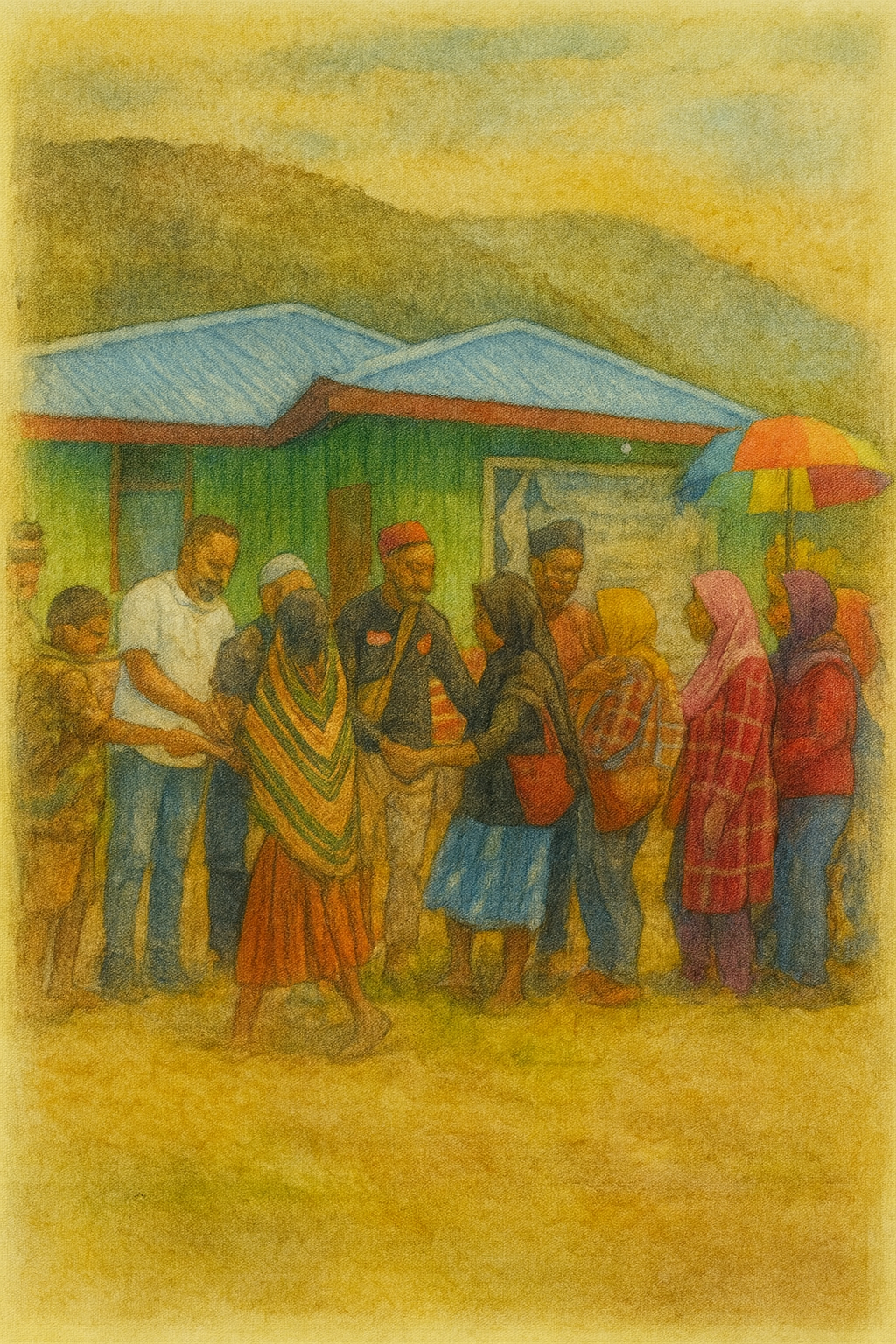
Village administration plays a crucial role in strengthening transparency, accountability, and efficiency in local governance, particularly in rural Indonesia. This study aims to evaluate the implementation of village administration across five mandated governance domains—general, population, financial, development, and other administration—using evidence from the Apenas Village Office in Jayawijaya Regency. Employing a descriptive quantitative design with saturated sampling, data were collected from all village officials through structured questionnaires, direct observation, and document review, and analyzed using descriptive statistics to assess performance levels. The results reveal an overall “good” performance with a mean score of 47.76, though variation across domains was significant. General, population, and development administration performed very well due to standardized procedures and visible outcomes, while financial administration scored lower because of weaknesses in budgeting and financial literacy. The lowest performance was found in “other administration,” which involves documenting village deliberations, BPD activities, and adat institutions, reflecting challenges in inter-institutional coordination. These findings align with existing studies showing that routine, internal tasks are performed more effectively than functions requiring technical expertise or broader participation. Theoretically, the study reinforces institutional and participatory governance frameworks, while practically, it underscores the importance of capacity-building, financial training, and participatory documentation. Policy implications include the need for differentiated interventions that strengthen weaker domains while maintaining consistency in routine administration. By highlighting both strengths and weaknesses, this study contributes to the literature on village governance and offers valuable insights for improving local administration in Indonesia.
Keywords
Article Details
Copyright (c) 2025 Irsan Yelipele

This work is licensed under a Creative Commons Attribution-ShareAlike 4.0 International License.
- Authors retain copyright and grant the journal right of first publication with the work simultaneously licensed under a Creative Commons Attribution License that allows others to share the work with an acknowledgement of the work's authorship and initial publication in this journal.
- Authors are able to enter into separate, additional contractual arrangements for the non-exclusive distribution of the journal's published version of the work (e.g., post it to an institutional repository or publish it in a book), with an acknowledgement of its initial publication in this journal.
- Authors are permitted and encouraged to post their work online (e.g., in institutional repositories or on their website) prior to and during the submission process, as it can lead to productive exchanges, as well as earlier and greater citation of published work.