
Article Sidebar
Main Article Content
Abstract
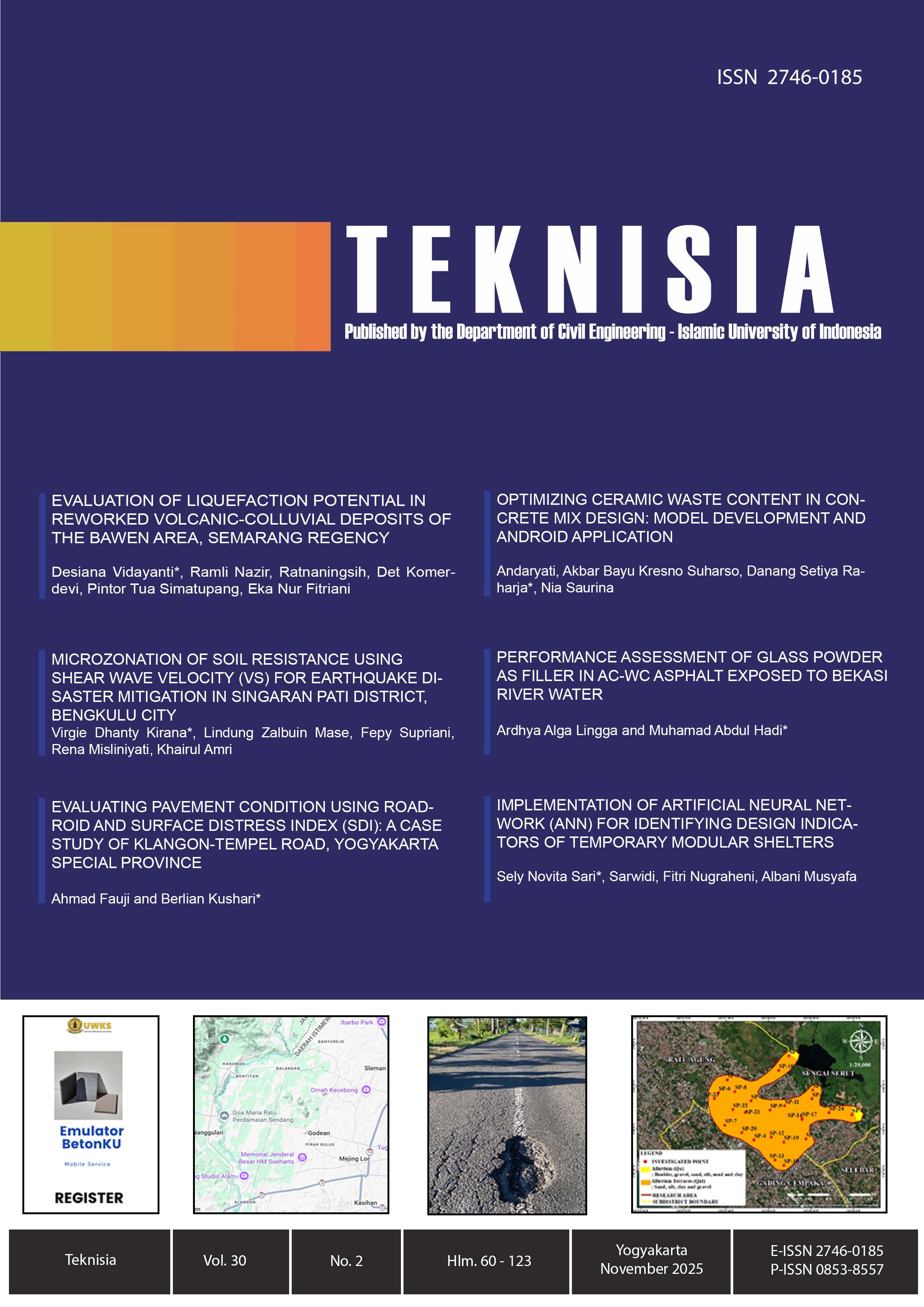
The demand for fast, efficient, and adaptive emergency housing continues to increase, especially in disaster-prone areas and large-scale displacement situations. The determination of the design of Temporary Modular Shelter (TMS) so far still depends a lot on subjective considerations, so a more systematic and data-based approach is needed. This study develops and validates an Artificial Neural Network (ANN) model to identify the most suitable TMS design based on performance indicators and expert assessment. The approach was carried out through the Systematic Literature Review (SLR) stage, the determination of eight key design indicators, and assessment by 150 multidisciplinary respondents. The ANN model was built using a dense four-layer architecture with a total of 1,780 parameters and trained for 400 epochs using the TensorFlow and Keras libraries. The results showed a validation accuracy of 96% and a macro F1-score of 0,9146, indicating the stability and reliability of the model. Analysis of the contribution of features with the SHAP method revealed that the indicators of assembly methods, availability of human resources, and availability of local materials had the greatest influence on the classification results. This model has proven to be effective as a decision support system that is able to increase objectivity and efficiency in the TMS design process. Further development is suggested through integration into web-based digital platforms or mobile applications to support rapid and adaptive emergency response planning.
Keywords
Article Details
Copyright (c) 2025 Sely Novita Sari, Sarwidi, Fitri Nugraheni, Albani Musyafa'

This work is licensed under a Creative Commons Attribution-ShareAlike 4.0 International License.
Under the following term:
-
Attribution — You must give appropriate credit, provide a link to the license, and indicate if changes were made. You may do so in any reasonable manner, but not in any way that suggests the licensor endorses you or your use.
-
ShareAlike — If you remix, transform, or build upon the material, you must distribute your contributions under the same license as the original.
- No additional restrictions — You may not apply legal terms or technological measures that legally restrict others from doing anything the license permits.
References
- Babu, G. (2025). Assessing the viability of foldable-expandable container homes for post-disaster housing in New Zealand.
- Baghdadi, A., Heristchian, M., & Kloft, H. (2021). Connections placement optimization approach toward new prefabricated building systems. Engineering Structures, 233, 111648. https://doi.org/10.1016/j.engstruct.2020.111648
- Birjukov, A., & Bolotin, S. (2015). Construction of Temporary Accommodation Camp and Selection of Optimal Type of Building. In Applied Mechanics and Materials (Vol. 725, pp. 105–110). Trans Tech Publications, Ltd. https://doi.org/10.4028/www.scientific.net/amm.725-726.105
- Boucetta, Z., Fazziki, A., & Adnani, M. (2021). A Deep-Learning-Based Road Deterioration Notification and Road Condition Monitoring Framework. International Journal of Intelligent Engineering and Systems, 14(3), 503–515. https://doi.org/10.22266/ijies2021.0630.42
- Chen, T., & Guestrin, C. (2016). XGBoost. Proceedings of the 22nd ACM SIGKDD International Conference on Knowledge Discovery and Data Mining, 785–794. https://doi.org/10.1145/2939672.2939785
- Chollet, F. (2021). Deep learning with Python. simon and schuster.
- Citaristi, I. (2022). United Nations high commissioner for refugees UNHCR. In The Europa Directory of International Organizations 2022 (pp. 220–240). Routledge.
- Conzatti, A., Kershaw, T., Copping, A., & Coley, D. (2022). A review of the impact of shelter design on the health of displaced populations. In Journal of International …. Springer. https://doi.org/10.1186/s41018-022-00123-0
- Dash, S. P., Pati, D. J., Mohamed, Z. S., & Ramesh, S. (2022). To study the material feasibility and propose design prototype for temporary housing structures for emergency relief. Materials Today: Proceedings, 60, 123–131. https://doi.org/10.1016/j.matpr.2021.12.274
- Ghomi, S. G., Wedawatta, G., Ginige, K., & Ingirige, B. (2021). Living-transforming disaster relief shelter: a conceptual approach for sustainable post-disaster housing. In Built Environment Project and Asset Management (Vol. 11, Issue 4, pp. 687–704). Emerald. https://doi.org/10.1108/bepam-04-2020-0076
- Guo, N., Davis, A., Mauter, M., & Whitacre, J. (2021). Real-time feedback improves multi-stakeholder design for complex environmental systems. Environmental Research Communications, 3(4), 045006. https://doi.org/10.1088/2515-7620/abf466
- Hafez, M., Ksaibati, K., & Atadero, R. A. (2019). Optimizing Expert-Based Decision-Making of Pavement Maintenance using Artificial Neural Networks with Pattern-Recognition Algorithms. Transportation Research Record: Journal of the Transportation Research Board, 2673(11), 90–100. https://doi.org/10.1177/0361198119851085
- Hamdan, M., Abd Elhamid, F., & Dabbour, L. (2021). Impact of Passive Techniques on Thermal Behavior of Emergency Shelters. Ecological Engineering & Environmental Technology, 22(3), 112–119. https://doi.org/10.12912/27197050/135523
- Jahn, T., & Jin, B. (2024). Early Stopping of Untrained Convolutional Neural Networks. SIAM Journal on Imaging Sciences, 17(4), 2331–2361. https://doi.org/10.1137/24M1636617
- Jia, J., & Ye, W. (2023). Deep Learning for Earthquake Disaster Assessment: Objects, Data, Models, Stages, Challenges, and Opportunities. Remote Sensing, 15(16), 4098. https://doi.org/10.3390/rs15164098
- Kaklauskas, A., Dzemyda, G., Tupenaite, L., Voitau, I., Kurasova, O., Naimaviciene, J., Rassokha, Y., & Kanapeckiene, L. (2018). Artificial Neural Network-Based Decision Support System for Development of an Energy-Efficient Built Environment. Energies, 11(8), 1994. https://doi.org/10.3390/en11081994
- Khadka, A. K. (2025). Thermal Comfort in Post-Disaster Reconstructed Shelters: A Case Study of the 2023 Jajarkot Earthquake.
- Leavy, P. (2022). Research design: Quantitative, qualitative, mixed methods, arts-based, and community-based participatory research approaches. Guilford publications.
- Makadi, Y. C., Arlikatti, S., Zewdu, D., & Maghelal, P. (2025). Review of Temporary Shelter Planning Models: Global Trends and Evidence from Ongoing Practices. Natural Hazards Review, 26(4). https://doi.org/10.1061/NHREFO.NHENG-2339
- Montalbano, G., & Santi, G. (2023). Sustainability of Temporary Housing in Post-Disaster Scenarios: A Requirement-Based Design Strategy. Buildings, 13(12), 2952. https://doi.org/10.3390/buildings13122952
- Muksin, Z., Rahim, A., Hermansyah, A., Samudra, A. A., & Satispi, E. (2023). Earthquake Disaster Mitigation in Cianjur. JIIP - Jurnal Ilmiah Ilmu Pendidikan, 6(4), 2486–2490. https://doi.org/10.54371/jiip.v6i4.1847
- Nabi, M. A., & El-adaway, I. H. (2020). Modular Construction: Determining Decision-Making Factors and Future Research Needs. Journal of Management in Engineering, 36(6). https://doi.org/10.1061/(ASCE)ME.1943-5479.0000859
- Nekooie, M. A., & Tofighi, M. (2020). Resilient and sustainable modular system for temporary sheltering in emergency condition. Vitruvio, 5(2), 1–18. https://doi.org/10.4995/vitruvio-ijats.2020.11946
- Obyn, S., Moeseke, G. van, & Virgo, V. (2014). The thermal performance of shelter modelling: improvement of temporary structures. In WIT Transactions on The Built Environment. WIT Press. https://doi.org/10.2495/mar140071
- Osuizugbo, I. C. (2021). The need for and benefits of buildability analysis: Nigeria as a case study. Journal of Engineering, Design and Technology, 19(5), 1207–1230. https://doi.org/10.1108/JEDT-08-2020-0338
- Papatheodorou, K., Theodoulidis, N., Klimis, N., Zulfikar, C., Vintila, D., Cardanet, V., Kirtas, E., Toma-Danila, D., Margaris, B., Fahjan, Y., Panagopoulos, G., Karakostas, C., Papathanassiou, G., & Valkaniotis, S. (2023). Rapid Earthquake Damage Assessment and Education to Improve Earthquake Response Efficiency and Community Resilience. Sustainability, 15(24), 16603. https://doi.org/10.3390/su152416603
- Pratama, B. G., Sari, S. N., & Prasojo, J. (2025). Application of Genetic Algorithm Neural Network in Identifying Buildings in Landslide-Prone Areas. G-Tech: Jurnal Teknologi Terapan, 9(3), 1237–1247. https://doi.org/10.70609/g-tech.v9i3.7168
- Pratama, B. G., Sari, S. N., & Yuliani, O. (2025). Classification Based on Artificial Neural Network for Regency Road Maintenance Priority. Aviation Electronics, Information Technology, Telecommunications, Electricals, and Controls (AVITEC), 7(3).
- Samek, W., Montavon, G., Lapuschkin, S., Anders, C. J., & Muller, K.-R. (2021). Explaining Deep Neural Networks and Beyond: A Review of Methods and Applications. Proceedings of the IEEE, 109(3), 247–278. https://doi.org/10.1109/JPROC.2021.3060483
- Sari, S. N., & Nugraheni, F. (2024). Planning Temporary Modular Shelter as a Temporary Housing Solution: Systematic Literature Review. G-Tech : Jurnal Teknologi Terapan, 8(1), 2632–2641. https://ejournal.uniramalang.ac.id/index.php/g-tech/article/view/1823/1229
- Sari, S. N., Pratama, B. G., & Ircham, I. (2024). Collaboration of Artificial Neural Network (JST) in Identifying Priorities for Handling District Road Maintenance. Device, 14(1), 19–29. https://doi.org/10.32699/device.v14i1.6702
- Sari, S. N., Pratama, B. G., & Prastowo, R. (2024). Artificial Neural Network (ANN) Modeling for Landslide-Prone Buildings. Device, 14(1), 8–18. https://doi.org/10.32699/device.v14i1.6701
- Sari, S. N., Sarwidi, Nugraheni, F., & Musyafa, A. (2025a). Decision Tree-Based Expert System Planning To Support Temporary Housing Design Decision Making After Earthquake Disasters In Indonesia. International Journal of Environmental Sciences, 2162–2169. https://doi.org/10.64252/27ra1s71
- Sari, S. N., Sarwidi, S., Nugraheni, F., & Musyafa, A. (2025b). Identification of Characteristics of Temporary Modular Shelter Design in Disasters in Indonesia through Nvivo and Literature Review. Jurnal Penelitian Inovatif, 5(3), 1929–1938.
- Sari, S. N., Winarno, S., & Nugraheni, F. (2024). Identification Of Temporary Housing Design Indicators From The Perspective. 9(2), 143–152. https://doi.org/10.33579/krvtk.v9i2.5072
- Tsamardinos, I., Greasidou, E., & Borboudakis, G. (2018). Bootstrapping the out-of-sample predictions for efficient and accurate cross-validation. Machine Learning, 107(12), 1895–1922. https://doi.org/10.1007/s10994-018-5714-4
- Xie, C., Gao, H., Huang, Y., Xue, Z., Xu, C., & Dai, K. (2025). Leveraging the DeepSeek large model: A framework for AI-assisted disaster prevention, mitigation, and emergency response systems. Earthquake Research Advances, 100378. https://doi.org/10.1016/j.eqrea.2025.100378
- Zhu, W., Xing, H., & Kang, W. (2023). Spatial Layout Planning of Urban Emergency Shelter Based on Sustainable Disaster Reduction. In International Journal of Environmental Research and Public Health (Vol. 20, Issue 3, p. 2127). MDPI AG. https://doi.org/10.3390/ijerph20032127
References
Babu, G. (2025). Assessing the viability of foldable-expandable container homes for post-disaster housing in New Zealand.
Baghdadi, A., Heristchian, M., & Kloft, H. (2021). Connections placement optimization approach toward new prefabricated building systems. Engineering Structures, 233, 111648. https://doi.org/10.1016/j.engstruct.2020.111648
Birjukov, A., & Bolotin, S. (2015). Construction of Temporary Accommodation Camp and Selection of Optimal Type of Building. In Applied Mechanics and Materials (Vol. 725, pp. 105–110). Trans Tech Publications, Ltd. https://doi.org/10.4028/www.scientific.net/amm.725-726.105
Boucetta, Z., Fazziki, A., & Adnani, M. (2021). A Deep-Learning-Based Road Deterioration Notification and Road Condition Monitoring Framework. International Journal of Intelligent Engineering and Systems, 14(3), 503–515. https://doi.org/10.22266/ijies2021.0630.42
Chen, T., & Guestrin, C. (2016). XGBoost. Proceedings of the 22nd ACM SIGKDD International Conference on Knowledge Discovery and Data Mining, 785–794. https://doi.org/10.1145/2939672.2939785
Chollet, F. (2021). Deep learning with Python. simon and schuster.
Citaristi, I. (2022). United Nations high commissioner for refugees UNHCR. In The Europa Directory of International Organizations 2022 (pp. 220–240). Routledge.
Conzatti, A., Kershaw, T., Copping, A., & Coley, D. (2022). A review of the impact of shelter design on the health of displaced populations. In Journal of International …. Springer. https://doi.org/10.1186/s41018-022-00123-0
Dash, S. P., Pati, D. J., Mohamed, Z. S., & Ramesh, S. (2022). To study the material feasibility and propose design prototype for temporary housing structures for emergency relief. Materials Today: Proceedings, 60, 123–131. https://doi.org/10.1016/j.matpr.2021.12.274
Ghomi, S. G., Wedawatta, G., Ginige, K., & Ingirige, B. (2021). Living-transforming disaster relief shelter: a conceptual approach for sustainable post-disaster housing. In Built Environment Project and Asset Management (Vol. 11, Issue 4, pp. 687–704). Emerald. https://doi.org/10.1108/bepam-04-2020-0076
Guo, N., Davis, A., Mauter, M., & Whitacre, J. (2021). Real-time feedback improves multi-stakeholder design for complex environmental systems. Environmental Research Communications, 3(4), 045006. https://doi.org/10.1088/2515-7620/abf466
Hafez, M., Ksaibati, K., & Atadero, R. A. (2019). Optimizing Expert-Based Decision-Making of Pavement Maintenance using Artificial Neural Networks with Pattern-Recognition Algorithms. Transportation Research Record: Journal of the Transportation Research Board, 2673(11), 90–100. https://doi.org/10.1177/0361198119851085
Hamdan, M., Abd Elhamid, F., & Dabbour, L. (2021). Impact of Passive Techniques on Thermal Behavior of Emergency Shelters. Ecological Engineering & Environmental Technology, 22(3), 112–119. https://doi.org/10.12912/27197050/135523
Jahn, T., & Jin, B. (2024). Early Stopping of Untrained Convolutional Neural Networks. SIAM Journal on Imaging Sciences, 17(4), 2331–2361. https://doi.org/10.1137/24M1636617
Jia, J., & Ye, W. (2023). Deep Learning for Earthquake Disaster Assessment: Objects, Data, Models, Stages, Challenges, and Opportunities. Remote Sensing, 15(16), 4098. https://doi.org/10.3390/rs15164098
Kaklauskas, A., Dzemyda, G., Tupenaite, L., Voitau, I., Kurasova, O., Naimaviciene, J., Rassokha, Y., & Kanapeckiene, L. (2018). Artificial Neural Network-Based Decision Support System for Development of an Energy-Efficient Built Environment. Energies, 11(8), 1994. https://doi.org/10.3390/en11081994
Khadka, A. K. (2025). Thermal Comfort in Post-Disaster Reconstructed Shelters: A Case Study of the 2023 Jajarkot Earthquake.
Leavy, P. (2022). Research design: Quantitative, qualitative, mixed methods, arts-based, and community-based participatory research approaches. Guilford publications.
Makadi, Y. C., Arlikatti, S., Zewdu, D., & Maghelal, P. (2025). Review of Temporary Shelter Planning Models: Global Trends and Evidence from Ongoing Practices. Natural Hazards Review, 26(4). https://doi.org/10.1061/NHREFO.NHENG-2339
Montalbano, G., & Santi, G. (2023). Sustainability of Temporary Housing in Post-Disaster Scenarios: A Requirement-Based Design Strategy. Buildings, 13(12), 2952. https://doi.org/10.3390/buildings13122952
Muksin, Z., Rahim, A., Hermansyah, A., Samudra, A. A., & Satispi, E. (2023). Earthquake Disaster Mitigation in Cianjur. JIIP - Jurnal Ilmiah Ilmu Pendidikan, 6(4), 2486–2490. https://doi.org/10.54371/jiip.v6i4.1847
Nabi, M. A., & El-adaway, I. H. (2020). Modular Construction: Determining Decision-Making Factors and Future Research Needs. Journal of Management in Engineering, 36(6). https://doi.org/10.1061/(ASCE)ME.1943-5479.0000859
Nekooie, M. A., & Tofighi, M. (2020). Resilient and sustainable modular system for temporary sheltering in emergency condition. Vitruvio, 5(2), 1–18. https://doi.org/10.4995/vitruvio-ijats.2020.11946
Obyn, S., Moeseke, G. van, & Virgo, V. (2014). The thermal performance of shelter modelling: improvement of temporary structures. In WIT Transactions on The Built Environment. WIT Press. https://doi.org/10.2495/mar140071
Osuizugbo, I. C. (2021). The need for and benefits of buildability analysis: Nigeria as a case study. Journal of Engineering, Design and Technology, 19(5), 1207–1230. https://doi.org/10.1108/JEDT-08-2020-0338
Papatheodorou, K., Theodoulidis, N., Klimis, N., Zulfikar, C., Vintila, D., Cardanet, V., Kirtas, E., Toma-Danila, D., Margaris, B., Fahjan, Y., Panagopoulos, G., Karakostas, C., Papathanassiou, G., & Valkaniotis, S. (2023). Rapid Earthquake Damage Assessment and Education to Improve Earthquake Response Efficiency and Community Resilience. Sustainability, 15(24), 16603. https://doi.org/10.3390/su152416603
Pratama, B. G., Sari, S. N., & Prasojo, J. (2025). Application of Genetic Algorithm Neural Network in Identifying Buildings in Landslide-Prone Areas. G-Tech: Jurnal Teknologi Terapan, 9(3), 1237–1247. https://doi.org/10.70609/g-tech.v9i3.7168
Pratama, B. G., Sari, S. N., & Yuliani, O. (2025). Classification Based on Artificial Neural Network for Regency Road Maintenance Priority. Aviation Electronics, Information Technology, Telecommunications, Electricals, and Controls (AVITEC), 7(3).
Samek, W., Montavon, G., Lapuschkin, S., Anders, C. J., & Muller, K.-R. (2021). Explaining Deep Neural Networks and Beyond: A Review of Methods and Applications. Proceedings of the IEEE, 109(3), 247–278. https://doi.org/10.1109/JPROC.2021.3060483
Sari, S. N., & Nugraheni, F. (2024). Planning Temporary Modular Shelter as a Temporary Housing Solution: Systematic Literature Review. G-Tech : Jurnal Teknologi Terapan, 8(1), 2632–2641. https://ejournal.uniramalang.ac.id/index.php/g-tech/article/view/1823/1229
Sari, S. N., Pratama, B. G., & Ircham, I. (2024). Collaboration of Artificial Neural Network (JST) in Identifying Priorities for Handling District Road Maintenance. Device, 14(1), 19–29. https://doi.org/10.32699/device.v14i1.6702
Sari, S. N., Pratama, B. G., & Prastowo, R. (2024). Artificial Neural Network (ANN) Modeling for Landslide-Prone Buildings. Device, 14(1), 8–18. https://doi.org/10.32699/device.v14i1.6701
Sari, S. N., Sarwidi, Nugraheni, F., & Musyafa, A. (2025a). Decision Tree-Based Expert System Planning To Support Temporary Housing Design Decision Making After Earthquake Disasters In Indonesia. International Journal of Environmental Sciences, 2162–2169. https://doi.org/10.64252/27ra1s71
Sari, S. N., Sarwidi, S., Nugraheni, F., & Musyafa, A. (2025b). Identification of Characteristics of Temporary Modular Shelter Design in Disasters in Indonesia through Nvivo and Literature Review. Jurnal Penelitian Inovatif, 5(3), 1929–1938.
Sari, S. N., Winarno, S., & Nugraheni, F. (2024). Identification Of Temporary Housing Design Indicators From The Perspective. 9(2), 143–152. https://doi.org/10.33579/krvtk.v9i2.5072
Tsamardinos, I., Greasidou, E., & Borboudakis, G. (2018). Bootstrapping the out-of-sample predictions for efficient and accurate cross-validation. Machine Learning, 107(12), 1895–1922. https://doi.org/10.1007/s10994-018-5714-4
Xie, C., Gao, H., Huang, Y., Xue, Z., Xu, C., & Dai, K. (2025). Leveraging the DeepSeek large model: A framework for AI-assisted disaster prevention, mitigation, and emergency response systems. Earthquake Research Advances, 100378. https://doi.org/10.1016/j.eqrea.2025.100378
Zhu, W., Xing, H., & Kang, W. (2023). Spatial Layout Planning of Urban Emergency Shelter Based on Sustainable Disaster Reduction. In International Journal of Environmental Research and Public Health (Vol. 20, Issue 3, p. 2127). MDPI AG. https://doi.org/10.3390/ijerph20032127