
Article Sidebar
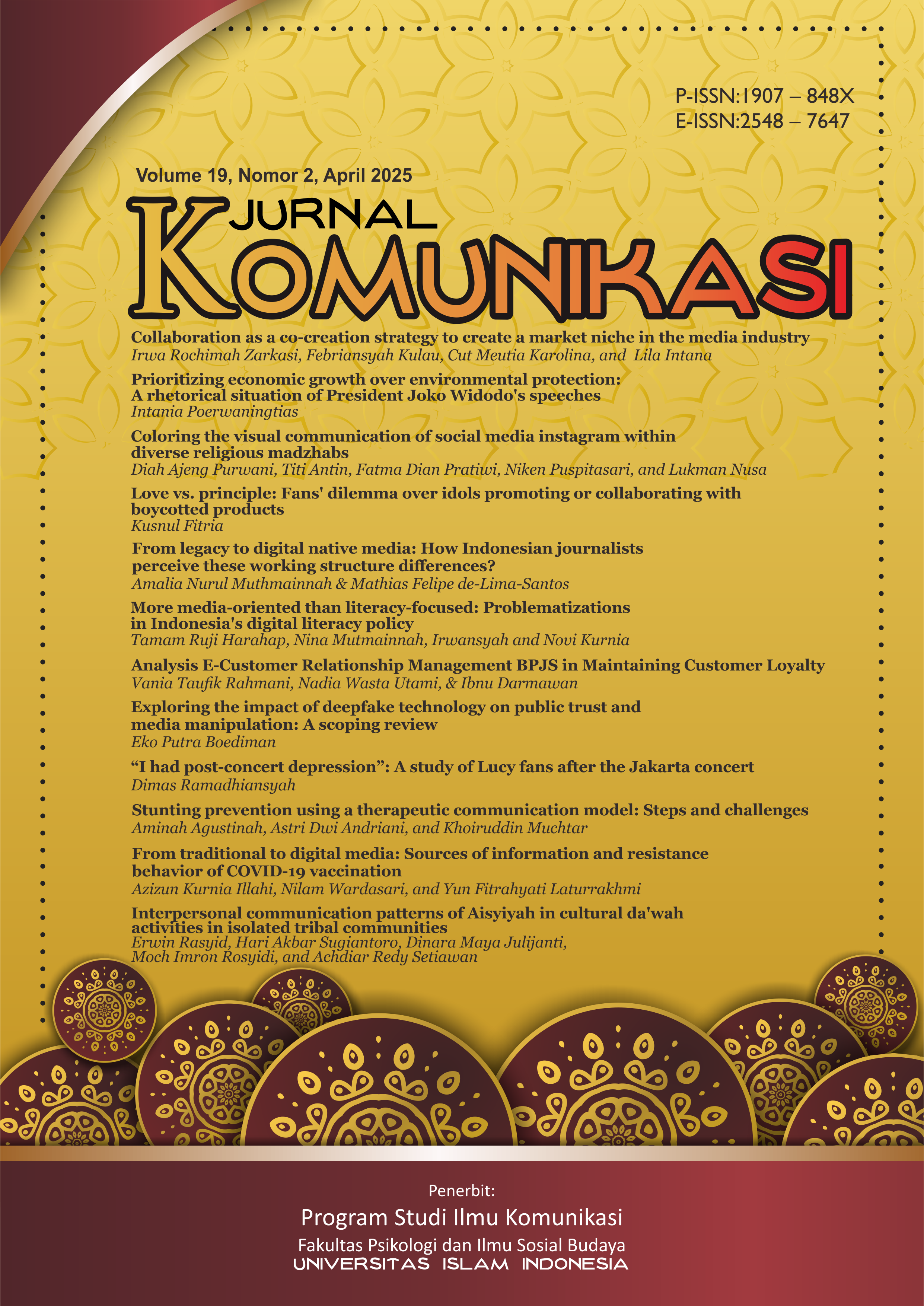
Main Article Content
Abstract
This article aims to analyze the using of different color in visual communication of social media especially Instagram used by yukngaji communities in Yogyakarta and Riau. These different colors are some kind of representing the different religion madzab that tried to be removed in the realm of unity in diversity and peace. We use virtual ethnography to analyze the content of Instagram accounts @ynjogya and @yukngajipku. The finding of the study indicates that there are three finding related to the research questions. First, the use of dynamic colors. Second, the visualization of religious learning activities, as analyzed in this research, namely the activities of conveying religious teachings by the community via social media is divided into several things. Last, the use of vocabulary containing anti-SARA, such as all forms of preaching content uploaded on social media platforms.
Keywords
Article Details
Copyright (c) 2025 Diah Ajeng Purwani, Titi Antin, Fatma Dian Pratiwi, Niken Puspitasari, Lukman Nusa

This work is licensed under a Creative Commons Attribution-ShareAlike 4.0 International License.
Authors who publish with this journal agree to the following terms:
- Authors retain copyright and grant the journal right of first publication with the work simultaneously licensed under a Creative Commons Attribution License that allows others to share the work with an acknowledgement of the work's authorship and initial publication in this journal.
- Authors are able to enter into separate, additional contractual arrangements for the non-exclusive distribution of the journal's published version of the work (e.g., post it to an institutional repository or publish it in a book), with an acknowledgement of its initial publication in this journal.
- Authors are permitted and encouraged to post their work online (e.g., in institutional repositories or on their website) prior to and during the submission process, as it can lead to productive exchanges, as well as earlier and greater citation of published work (See The Effect of Open Access).




References
- Adiloglu, F. (2011). Visual communication: Design studio education through working the process. Procedia - Social and Behavioral Sciences, 28, 982–991. https://doi.org/10.1016/J.SBSPRO.2011.11.182
- Aisy, B. R., Ibrahim, D. O., Intang, K. K. H., & Tindage, M. A. (2019). Penegakan kontra radikalisasi melalui media sosial oleh pemerintah dalam menangkal radikalisme. Jurnal Hukum Magnum Opus, 2(1), 1. https://doi.org/10.30996/jhmo.v2i2.2174
- Aliyah, I., Setioko, B., & Pradoto, W. (2017). Spatial flexibility in cultural mapping of traditional market area in Surakarta (A case study of Pasar Gede in Surakarta). City, Culture and Society. https://doi.org/10.1016/j.ccs.2017.05.004
- Annazilli, H. (2018). Relasi antara agama dan media baru. Jurnal Ilmiah Syi’ar, 18(2), 26. https://doi.org/10.29300/syr.v18i2.1677
- Azizah, L., & Nuruddin, N. (2021). Konflik sosial keagamaan dimasa pandemi covid-19. SANGKéP: Jurnal Kajian Sosial Keagamaan, 4(1), 94–108. https://doi.org/10.20414/sangkep.v4i1.2421
- Bate, S. P. (1997). Whatever happened to organizational anthropology? A review of the field of organizational ethnography and anthropological studies. Human Relations, 50(9), 1147–1175. https://doi.org/10.1177/001872679705000905/ASSET/001872679705000905.FP.PNG_V03
- Beta, A. R. (2014). Hijabers: How young urban muslim women redefine themselves in Indonesia. International Communication Gazette, 76(4–5), 377–389. https://doi.org/10.1177/1748048514524103
- Bhowon, U., & Bundhoo, H. (2016). Perceptions and reasons for veiling: A qualitative study. Psychology and Developing Societies, 28(1), 29–49. https://doi.org/10.1177/0971333615622894
- Bruinessen, M. van. (2021). Traditionalist and islamist pesantrens in contemporary Indonesia. In The Madrasa in Asia. https://doi.org/10.1017/9789048501380.009
- Caesar Effendi, A., Purwanto, L., Pawiyatan Luhur, J. I., Duwur, B., -, S., & Alamat, I. (2021). Kajian literatur : Etnografi digital sebagai cara baru dalam pencarian data dalam proses perencanaan arsitektur. Aksen : Journal of Design and Creative Industry, 6(1), 19–31. https://doi.org/10.37715/AKSEN.V6I1.2103
- Ciptadi, S. G. (2024). The social construction of tolerance discourse through online media: Study of NU online. Komunika: Jurnal Dakwah Dan Komunikasi, 18(1), 113–123. https://doi.org/10.24090/komunika.v18i1.8431
- Creswell, J. W. . (2017). Qualitative inquiry and research design (International student edition). Choosing among five approaches. 488. https://books.google.com/books/about/Qualitative_Inquiry_and_Research_Design.html?hl=id&id=gX1ZDwAAQBAJ
- Domiszewska, M. (2023). The role of colour in visual communication. Iris Journal of Economics & Business Management, 1(3), 2–3. https://doi.org/10.33552/ijebm.2023.01.000515
- Echchaibi, N. (2007). Republican betrayal: Beur FM and the suburban riots in France. Journal of Intercultural Studies, 28(3), 301–316. https://doi.org/10.1080/07256860701429725
- Engelkamp, S., Roepstorff, K., & Spencer, A. (2020). Visualizing peace – The state of the art. Peace & Change, 45(1), 5–27. https://doi.org/10.1111/PECH.12384
- Estuningtyas, R. D. (2021). Strategi komunikasi dan dakwah pada kalangan milenial di era modernisasi. Muttaqien; Indonesian Journal of Multidiciplinary Islamic Studies. https://doi.org/10.52593/mtq.02.1.05
- Fanindy, M. N., & Mupida, S. (2021). The shift of literacy among millennials as the result of radicalism spreading in social media. Millah: Journal of Religious Studies, 20(2), 195–222. https://doi.org/10.20885/millah.vol20.iss2.art1
- Febriyanti, S. N., & Tutiasri, R. P. (2018). Etika komunikasi netizen di media sosial. Jurnal Ilmu Komunikasi, 1(1). https://doi.org/10.33005/jkom.v1i1.5
- Ghifari, I. F. (2017). Radikalisme di internet. Religious: Jurnal Studi Agama-Agama Dan Lintas Budaya, 1(2), 123. https://doi.org/10.15575/rjsalb.v1i2.1391
- Hasan, N. (2000). In search of identity: The contemporary islamic communities in Southeast Asia. In Studia Islamika (Vol. 7, Issue 3, pp. 69–110). Gedung Pusat Pengkajian Islam dan Masyarakat (PPIM) UIN Jakarta. https://doi.org/10.15408/sdi.v7i3.703
- Hasan, N. (2008). Noorhaidi Hasan Laskar Jihad: Islam, militancy, and the quest for identity in post-new order Indonesia Ithaca, New York: Cornell Southeast Asia Program Publications. 2006, 266p. Southeast Asia: History and Culture, 2008(37), 171–176. https://doi.org/10.5512/sea.2008.37_171
- Hasan, N. (2019). The salafi madrasas of Indonesia. In The Madrasa in Asia (pp. 247–274). https://doi.org/10.1515/9789048501380-011
- Hasan, N. (2021). Political Islam in Indonesia Noorhaidi Hasan. In The Politics of Religion in South and Southeast Asia (pp. 148–168). Routledge. https://doi.org/10.4324/9780203817131-13
- Hasan, N. (2022). Decentering Islamic Studies. Islamic Studies Review, 1(1), 1–5. https://doi.org/10.56529/isr.v1i1.34
- Hoesterey, J. B., & Clark, M. (2012). Film Islami: Gender, piety and pop culture in post-authoritarian Indonesia. Asian Studies Review, 36(2), 207–226. https://doi.org/10.1080/10357823.2012.685925
- Horst, H. (2017). Refiguring techniques in digital visual research. In E. Gómez Cruz, S. Sumartojo, & S. Pink (Eds.), Refiguring techniques in digital visual research. Springer International Publishing. https://doi.org/10.1007/978-3-319-61222-5
- Huda, A. Z., Runturambi, A. J. S., & Syauqillah, M. (2021). Social media as an incubator of youth terrorism in Indonesia: Hybrid threat and warfare. Jurnal Indo-Islamika, 11(1), 21–40. https://doi.org/10.15408/jii.v11i1.20362
- Huda, M. T., & Filla, O. F. (2018). Media sosial sebagai sarana membangun kerukunan pada komunitas young interfaith peacemaker (YIPC). Religious: Jurnal Studi Agama-Agama Dan Lintas Budaya, 3(1), 99–112. https://doi.org/10.14421/rejusta.2019.1501-03
- Jasmine, D., & Abdurrahman, M. S. (2020). Analisis kerja jurnalistik di media massa Tribunnews. com Pada Pemberitaan Kasus# JusticeForAudrey. EProceedings …, 7(2), 4265–4276.
- Jhon W, C. (2012). Planing, conducting and evaluating qualitative and quantitative research. Educational Research, 522.
- Jinan, M. (2015). Muhammadiyah Studies: The transformation of research on Islamic movement in Indonesia. Analisa, 22(2), 269. https://doi.org/10.18784/analisa.v22i2.96
- Jorge, M. E. D., & Muñoz, F. A. M. (2016). Uncovering the virtues of peace within visual culture: The case for nonviolence and imperfect peace in the western tradition. Peace & Change, 41(3), 329–353. https://doi.org/10.1111/PECH.12161
- Kaur-Gill, S., & Dutta, M. J. (2017). Digital ethnography. https://doi.org/10.1002/9781118901731.iecrm0271
- Kozinet, R. (2009). Netnography: Doing ethnographic research online (1st edn). SAGE Publications Ltd.
- Kwok, V. F. (2019). Using visual media in preaching will increase the effectiveness of communicating the biblical truth and the relevant applications. Sustainability (Switzerland), 11(1), 1–14. http://scioteca.caf.com/bitstream/handle/123456789/1091/RED2017-Eng-8ene.pdf?sequence=12&isAllowed=y%0Ahttp://dx.doi.org/10.1016/j.regsciurbeco.2008.06.005%0Ahttps://www.researchgate.net/publication/305320484_Sistem_Pembetungan_Terpusat_Strategi_Melestari
- Maharani, S., & T, N. A. (2024). Penyampaian pesan dakwah Ustadz Muhammad Nuzul Dzikri ada akun media sosial Instagram. Jurnal Komunikasi Dan Penyiaran Islam, 4(1), 55–72.
- Mueller, D. M. . (2017). Islam, politics and youth in Malaysia : The Pop-Islamist reinvention of PAS. Routledge. https://www.routledge.com/Islam-Politics-and-Youth-in-Malaysia-The-Pop-Islamist-Reinvention-of-PAS/Mueller/p/book/9780815373506
- Mufida, S., & Mustolehudin. (2020). New media dan konflik ekstrimis perempuan Indonesia. Jurnal Bimas Islam, 13(2), 345–370. https://doi.org/10.37302/jbi.v13i2.231
- Mupida, S. (2019). Media baru dan konflik politik islam di Indonesia. Idarotuna. https://doi.org/10.24014/idarotuna.v2i1.8185
- Muzakki, A. (2012). Islamic televangelism in changing Indonesia: Transmission, authority, and the politics of ideas. In Global and Local Televangelism (pp. 45–63). Palgrave Macmillan, London. https://doi.org/10.1057/9781137264817_3
- Nasrullah, R. (2016). Media sosial: Perspektif komunikasi, budaya dan sosioteknologi. Simbiossa Rekatama Media.
- Nusa, L., Pratiwi, F. D., Purwani, D. A., Puspitasari, N., Sulistyaningsih, & Virga, R. L. (2021). Milenial dan cyber religion. UIN Sunan Kalijaga.
- Pabbajah, M., Jubba, H., Widyanti, R., Pabbajah, T., & Iribaram, S. (2020). Internet of religion: Islam and new media construction of religious movements in Indonesia. https://doi.org/10.4108/eai.1-10-2019.2291750
- Pink, S. (2007). Doing sensory etnography (p. 282). http://books.google.com/books?id=1UPEPQAACAAJ&pgis=1
- Postill, J., & Pink, S. (2012). Social media ethnography: The digital researcher in a messy web. Media International Australia, 145, 123–134. https://doi.org/10.1177/1329878x1214500114
- Putri, D. N., Hairunnisa, & Riyanto, A. (2020). Efektivitas penggunaan komunikasi visual dalam penerapan kawasan tanpa rokok (Ktr) di RSUD I.A. Moeis Kota Samarinda. Ilmu Komunikasi, 8(3), 7.
- Raoufi, K., Taylor, C., Laurin, L., & Haapala, K. R. (2019). Visual communication methods and tools for sustainability performance assessment: Linking academic and industry perspectives. Procedia CIRP, 80(March), 215–220. https://doi.org/10.1016/j.procir.2019.01.087
- Roswantoro, A. (2018). Resolusi konflik dalam masyarakat religius Indonesia. Religió: Jurnal Studi Agama-Agama, 8(2), 186–208. https://doi.org/10.15642/religio.v8i2.785
- Sari, S. (2019). Literasi media pada generasi milenial di era digital. Profesional: Jurnal Komunikasi Dan Administrasi Publik, 6(2), 30–42. https://doi.org/10.37676/professional.v6i2.943
- Sazali, H., & Mustafa, A. (2023). New media dan penguatan moderasi beragama di Indonesia. Jurnal Komunikasi, 17(2), 167–184. https://doi.org/10.20885/komunikasi.vol17.iss2.art3
- Schmidt, L. (2021). Aesthetics of authority: ‘Islam nusantara’ and Islamic ‘radicalism’ in Indonesian film and social media. Religion, 51(2), 237–258. https://doi.org/10.1080/0048721X.2020.1868387
- Setianto, Y. P. (2015). Mediatization of religion: How the Indonesian Muslim diasporas mediatized Islamic practices. Journal of Media and Religion, 14(4), 230–244. https://doi.org/10.1080/15348423.2015.1116268
- Smith, K., Moriarty, S., Barbatsis, G., & Kenney, K. (2005). Visual communication: Theory, methods, and media. Laurence Erlbaum Associates.
- Ståhl, M., & Kaihovirta, H. (2019). Exploring visual communication and competencies through interaction with images in social media. Learning, Culture and Social Interaction, 21(March 2018), 250–266. https://doi.org/10.1016/j.lcsi.2019.03.003
- Syahputra, I. (2018). Penggunaan media sosial dan kemarahan religius dalam kasus pembakaran vihara di Kota Tanjung Balai, Indonesia. Epistemé: Jurnal Pengembangan Ilmu Keislaman, 13(1), 149–172. https://doi.org/10.21274/epis.2018.13.1.149-172
- Tami, R. (2019). The strategies of Islamic popular novels in the arena of cultural struggle in contemporary Indonesia. 302(Icclas 2018), 165–170. https://doi.org/10.2991/icclas-18.2019.44
- Taprial, V., & Kanwar, P. (2012). Understanding social media credibility. Climate Change 2013 - The Physical Science Basis.
- Tinovitasari, F., Yuliastanti, R., & Malati, F. (2017). Work discipline factors affecting employees performance of marketing subdivision of madika foundation in Surabaya. IJEBD (International Journal of Entrepreneurship and Business Development), 1(1), 23–38. https://doi.org/10.29138/IJEBD.V1I1.343
- Wagner, W., Sen, R., Permanadeli, R., & Howarth, C. S. (2012). The veil and Muslim women’s identity: Cultural pressures and resistance to stereotyping. Culture and Psychology, 18(4), 521–541. https://doi.org/10.1177/1354067X12456713
- Wajdi, F., Mahfud, C., & Fauzia, I. Y. (2021). The changing trend of islamic pop culture in Indonesian reform era. 2021. http://www.e-jurnal.staimuttaqien.ac.id/
- Wardani, W. G. W., & Muntazori, A. F. (2019). Islamic memes as media of da’wah for millennials generations: Analysis of visual language on Islamic memes with illustration style. Cultural Syndrome, 1(1), 61–78. https://doi.org/10.30998/cs.v1i1.16
- Watie, E. D. S. (2016). Komunikasi dan media sosial (Communications and social media). Jurnal The Messenger. https://doi.org/10.26623/themessenger.v3i2.270
- Watson, C. W. (2005). A popular Indonesian preacher: The significance of Aa Gymnastiar. In Journal of the Royal Anthropological Institute (Vol. 11, Issue 4, pp. 773–792). John Wiley & Sons, Ltd. https://doi.org/10.1111/j.1467-9655.2005.00261.x
- Weng, H. W. (2018). The art of dakwah: Social media, visual persuasion and the Islamist propagation of Felix Siauw. Indonesia and the Malay World, 46(134), 61–79. https://doi.org/10.1080/13639811.2018.1416757
- Zaid, B., Fedtke, J., Shin, D. D., El Kadoussi, A., & Ibahrine, M. (2022). Digital Islam and muslim millennials: How social media influencers reimagine religious authority and Islamic practices. Religions, 13(4). https://doi.org/10.3390/rel13040335
- Zeitzoff, T. (2019). More than just hurdles: How fieldwork difficulties provide insights into conflict. PS - Political Science and Politics, 52(3), 507–511. https://doi.org/10.1017/S1049096519000167
- Zulfikar, M. (2021). Komnas HAM mengakui hingga saat ini konflik keberagamaan di Indonesia masih tinggi. Antara News Riau. https://riau.antaranews.com/berita/247357/komnas-ham-mengakui-hingga-saat-ini-konflik-keberagamaan-di-indonesia-masih-tinggi
References
Adiloglu, F. (2011). Visual communication: Design studio education through working the process. Procedia - Social and Behavioral Sciences, 28, 982–991. https://doi.org/10.1016/J.SBSPRO.2011.11.182
Aisy, B. R., Ibrahim, D. O., Intang, K. K. H., & Tindage, M. A. (2019). Penegakan kontra radikalisasi melalui media sosial oleh pemerintah dalam menangkal radikalisme. Jurnal Hukum Magnum Opus, 2(1), 1. https://doi.org/10.30996/jhmo.v2i2.2174
Aliyah, I., Setioko, B., & Pradoto, W. (2017). Spatial flexibility in cultural mapping of traditional market area in Surakarta (A case study of Pasar Gede in Surakarta). City, Culture and Society. https://doi.org/10.1016/j.ccs.2017.05.004
Annazilli, H. (2018). Relasi antara agama dan media baru. Jurnal Ilmiah Syi’ar, 18(2), 26. https://doi.org/10.29300/syr.v18i2.1677
Azizah, L., & Nuruddin, N. (2021). Konflik sosial keagamaan dimasa pandemi covid-19. SANGKéP: Jurnal Kajian Sosial Keagamaan, 4(1), 94–108. https://doi.org/10.20414/sangkep.v4i1.2421
Bate, S. P. (1997). Whatever happened to organizational anthropology? A review of the field of organizational ethnography and anthropological studies. Human Relations, 50(9), 1147–1175. https://doi.org/10.1177/001872679705000905/ASSET/001872679705000905.FP.PNG_V03
Beta, A. R. (2014). Hijabers: How young urban muslim women redefine themselves in Indonesia. International Communication Gazette, 76(4–5), 377–389. https://doi.org/10.1177/1748048514524103
Bhowon, U., & Bundhoo, H. (2016). Perceptions and reasons for veiling: A qualitative study. Psychology and Developing Societies, 28(1), 29–49. https://doi.org/10.1177/0971333615622894
Bruinessen, M. van. (2021). Traditionalist and islamist pesantrens in contemporary Indonesia. In The Madrasa in Asia. https://doi.org/10.1017/9789048501380.009
Caesar Effendi, A., Purwanto, L., Pawiyatan Luhur, J. I., Duwur, B., -, S., & Alamat, I. (2021). Kajian literatur : Etnografi digital sebagai cara baru dalam pencarian data dalam proses perencanaan arsitektur. Aksen : Journal of Design and Creative Industry, 6(1), 19–31. https://doi.org/10.37715/AKSEN.V6I1.2103
Ciptadi, S. G. (2024). The social construction of tolerance discourse through online media: Study of NU online. Komunika: Jurnal Dakwah Dan Komunikasi, 18(1), 113–123. https://doi.org/10.24090/komunika.v18i1.8431
Creswell, J. W. . (2017). Qualitative inquiry and research design (International student edition). Choosing among five approaches. 488. https://books.google.com/books/about/Qualitative_Inquiry_and_Research_Design.html?hl=id&id=gX1ZDwAAQBAJ
Domiszewska, M. (2023). The role of colour in visual communication. Iris Journal of Economics & Business Management, 1(3), 2–3. https://doi.org/10.33552/ijebm.2023.01.000515
Echchaibi, N. (2007). Republican betrayal: Beur FM and the suburban riots in France. Journal of Intercultural Studies, 28(3), 301–316. https://doi.org/10.1080/07256860701429725
Engelkamp, S., Roepstorff, K., & Spencer, A. (2020). Visualizing peace – The state of the art. Peace & Change, 45(1), 5–27. https://doi.org/10.1111/PECH.12384
Estuningtyas, R. D. (2021). Strategi komunikasi dan dakwah pada kalangan milenial di era modernisasi. Muttaqien; Indonesian Journal of Multidiciplinary Islamic Studies. https://doi.org/10.52593/mtq.02.1.05
Fanindy, M. N., & Mupida, S. (2021). The shift of literacy among millennials as the result of radicalism spreading in social media. Millah: Journal of Religious Studies, 20(2), 195–222. https://doi.org/10.20885/millah.vol20.iss2.art1
Febriyanti, S. N., & Tutiasri, R. P. (2018). Etika komunikasi netizen di media sosial. Jurnal Ilmu Komunikasi, 1(1). https://doi.org/10.33005/jkom.v1i1.5
Ghifari, I. F. (2017). Radikalisme di internet. Religious: Jurnal Studi Agama-Agama Dan Lintas Budaya, 1(2), 123. https://doi.org/10.15575/rjsalb.v1i2.1391
Hasan, N. (2000). In search of identity: The contemporary islamic communities in Southeast Asia. In Studia Islamika (Vol. 7, Issue 3, pp. 69–110). Gedung Pusat Pengkajian Islam dan Masyarakat (PPIM) UIN Jakarta. https://doi.org/10.15408/sdi.v7i3.703
Hasan, N. (2008). Noorhaidi Hasan Laskar Jihad: Islam, militancy, and the quest for identity in post-new order Indonesia Ithaca, New York: Cornell Southeast Asia Program Publications. 2006, 266p. Southeast Asia: History and Culture, 2008(37), 171–176. https://doi.org/10.5512/sea.2008.37_171
Hasan, N. (2019). The salafi madrasas of Indonesia. In The Madrasa in Asia (pp. 247–274). https://doi.org/10.1515/9789048501380-011
Hasan, N. (2021). Political Islam in Indonesia Noorhaidi Hasan. In The Politics of Religion in South and Southeast Asia (pp. 148–168). Routledge. https://doi.org/10.4324/9780203817131-13
Hasan, N. (2022). Decentering Islamic Studies. Islamic Studies Review, 1(1), 1–5. https://doi.org/10.56529/isr.v1i1.34
Hoesterey, J. B., & Clark, M. (2012). Film Islami: Gender, piety and pop culture in post-authoritarian Indonesia. Asian Studies Review, 36(2), 207–226. https://doi.org/10.1080/10357823.2012.685925
Horst, H. (2017). Refiguring techniques in digital visual research. In E. Gómez Cruz, S. Sumartojo, & S. Pink (Eds.), Refiguring techniques in digital visual research. Springer International Publishing. https://doi.org/10.1007/978-3-319-61222-5
Huda, A. Z., Runturambi, A. J. S., & Syauqillah, M. (2021). Social media as an incubator of youth terrorism in Indonesia: Hybrid threat and warfare. Jurnal Indo-Islamika, 11(1), 21–40. https://doi.org/10.15408/jii.v11i1.20362
Huda, M. T., & Filla, O. F. (2018). Media sosial sebagai sarana membangun kerukunan pada komunitas young interfaith peacemaker (YIPC). Religious: Jurnal Studi Agama-Agama Dan Lintas Budaya, 3(1), 99–112. https://doi.org/10.14421/rejusta.2019.1501-03
Jasmine, D., & Abdurrahman, M. S. (2020). Analisis kerja jurnalistik di media massa Tribunnews. com Pada Pemberitaan Kasus# JusticeForAudrey. EProceedings …, 7(2), 4265–4276.
Jhon W, C. (2012). Planing, conducting and evaluating qualitative and quantitative research. Educational Research, 522.
Jinan, M. (2015). Muhammadiyah Studies: The transformation of research on Islamic movement in Indonesia. Analisa, 22(2), 269. https://doi.org/10.18784/analisa.v22i2.96
Jorge, M. E. D., & Muñoz, F. A. M. (2016). Uncovering the virtues of peace within visual culture: The case for nonviolence and imperfect peace in the western tradition. Peace & Change, 41(3), 329–353. https://doi.org/10.1111/PECH.12161
Kaur-Gill, S., & Dutta, M. J. (2017). Digital ethnography. https://doi.org/10.1002/9781118901731.iecrm0271
Kozinet, R. (2009). Netnography: Doing ethnographic research online (1st edn). SAGE Publications Ltd.
Kwok, V. F. (2019). Using visual media in preaching will increase the effectiveness of communicating the biblical truth and the relevant applications. Sustainability (Switzerland), 11(1), 1–14. http://scioteca.caf.com/bitstream/handle/123456789/1091/RED2017-Eng-8ene.pdf?sequence=12&isAllowed=y%0Ahttp://dx.doi.org/10.1016/j.regsciurbeco.2008.06.005%0Ahttps://www.researchgate.net/publication/305320484_Sistem_Pembetungan_Terpusat_Strategi_Melestari
Maharani, S., & T, N. A. (2024). Penyampaian pesan dakwah Ustadz Muhammad Nuzul Dzikri ada akun media sosial Instagram. Jurnal Komunikasi Dan Penyiaran Islam, 4(1), 55–72.
Mueller, D. M. . (2017). Islam, politics and youth in Malaysia : The Pop-Islamist reinvention of PAS. Routledge. https://www.routledge.com/Islam-Politics-and-Youth-in-Malaysia-The-Pop-Islamist-Reinvention-of-PAS/Mueller/p/book/9780815373506
Mufida, S., & Mustolehudin. (2020). New media dan konflik ekstrimis perempuan Indonesia. Jurnal Bimas Islam, 13(2), 345–370. https://doi.org/10.37302/jbi.v13i2.231
Mupida, S. (2019). Media baru dan konflik politik islam di Indonesia. Idarotuna. https://doi.org/10.24014/idarotuna.v2i1.8185
Muzakki, A. (2012). Islamic televangelism in changing Indonesia: Transmission, authority, and the politics of ideas. In Global and Local Televangelism (pp. 45–63). Palgrave Macmillan, London. https://doi.org/10.1057/9781137264817_3
Nasrullah, R. (2016). Media sosial: Perspektif komunikasi, budaya dan sosioteknologi. Simbiossa Rekatama Media.
Nusa, L., Pratiwi, F. D., Purwani, D. A., Puspitasari, N., Sulistyaningsih, & Virga, R. L. (2021). Milenial dan cyber religion. UIN Sunan Kalijaga.
Pabbajah, M., Jubba, H., Widyanti, R., Pabbajah, T., & Iribaram, S. (2020). Internet of religion: Islam and new media construction of religious movements in Indonesia. https://doi.org/10.4108/eai.1-10-2019.2291750
Pink, S. (2007). Doing sensory etnography (p. 282). http://books.google.com/books?id=1UPEPQAACAAJ&pgis=1
Postill, J., & Pink, S. (2012). Social media ethnography: The digital researcher in a messy web. Media International Australia, 145, 123–134. https://doi.org/10.1177/1329878x1214500114
Putri, D. N., Hairunnisa, & Riyanto, A. (2020). Efektivitas penggunaan komunikasi visual dalam penerapan kawasan tanpa rokok (Ktr) di RSUD I.A. Moeis Kota Samarinda. Ilmu Komunikasi, 8(3), 7.
Raoufi, K., Taylor, C., Laurin, L., & Haapala, K. R. (2019). Visual communication methods and tools for sustainability performance assessment: Linking academic and industry perspectives. Procedia CIRP, 80(March), 215–220. https://doi.org/10.1016/j.procir.2019.01.087
Roswantoro, A. (2018). Resolusi konflik dalam masyarakat religius Indonesia. Religió: Jurnal Studi Agama-Agama, 8(2), 186–208. https://doi.org/10.15642/religio.v8i2.785
Sari, S. (2019). Literasi media pada generasi milenial di era digital. Profesional: Jurnal Komunikasi Dan Administrasi Publik, 6(2), 30–42. https://doi.org/10.37676/professional.v6i2.943
Sazali, H., & Mustafa, A. (2023). New media dan penguatan moderasi beragama di Indonesia. Jurnal Komunikasi, 17(2), 167–184. https://doi.org/10.20885/komunikasi.vol17.iss2.art3
Schmidt, L. (2021). Aesthetics of authority: ‘Islam nusantara’ and Islamic ‘radicalism’ in Indonesian film and social media. Religion, 51(2), 237–258. https://doi.org/10.1080/0048721X.2020.1868387
Setianto, Y. P. (2015). Mediatization of religion: How the Indonesian Muslim diasporas mediatized Islamic practices. Journal of Media and Religion, 14(4), 230–244. https://doi.org/10.1080/15348423.2015.1116268
Smith, K., Moriarty, S., Barbatsis, G., & Kenney, K. (2005). Visual communication: Theory, methods, and media. Laurence Erlbaum Associates.
Ståhl, M., & Kaihovirta, H. (2019). Exploring visual communication and competencies through interaction with images in social media. Learning, Culture and Social Interaction, 21(March 2018), 250–266. https://doi.org/10.1016/j.lcsi.2019.03.003
Syahputra, I. (2018). Penggunaan media sosial dan kemarahan religius dalam kasus pembakaran vihara di Kota Tanjung Balai, Indonesia. Epistemé: Jurnal Pengembangan Ilmu Keislaman, 13(1), 149–172. https://doi.org/10.21274/epis.2018.13.1.149-172
Tami, R. (2019). The strategies of Islamic popular novels in the arena of cultural struggle in contemporary Indonesia. 302(Icclas 2018), 165–170. https://doi.org/10.2991/icclas-18.2019.44
Taprial, V., & Kanwar, P. (2012). Understanding social media credibility. Climate Change 2013 - The Physical Science Basis.
Tinovitasari, F., Yuliastanti, R., & Malati, F. (2017). Work discipline factors affecting employees performance of marketing subdivision of madika foundation in Surabaya. IJEBD (International Journal of Entrepreneurship and Business Development), 1(1), 23–38. https://doi.org/10.29138/IJEBD.V1I1.343
Wagner, W., Sen, R., Permanadeli, R., & Howarth, C. S. (2012). The veil and Muslim women’s identity: Cultural pressures and resistance to stereotyping. Culture and Psychology, 18(4), 521–541. https://doi.org/10.1177/1354067X12456713
Wajdi, F., Mahfud, C., & Fauzia, I. Y. (2021). The changing trend of islamic pop culture in Indonesian reform era. 2021. http://www.e-jurnal.staimuttaqien.ac.id/
Wardani, W. G. W., & Muntazori, A. F. (2019). Islamic memes as media of da’wah for millennials generations: Analysis of visual language on Islamic memes with illustration style. Cultural Syndrome, 1(1), 61–78. https://doi.org/10.30998/cs.v1i1.16
Watie, E. D. S. (2016). Komunikasi dan media sosial (Communications and social media). Jurnal The Messenger. https://doi.org/10.26623/themessenger.v3i2.270
Watson, C. W. (2005). A popular Indonesian preacher: The significance of Aa Gymnastiar. In Journal of the Royal Anthropological Institute (Vol. 11, Issue 4, pp. 773–792). John Wiley & Sons, Ltd. https://doi.org/10.1111/j.1467-9655.2005.00261.x
Weng, H. W. (2018). The art of dakwah: Social media, visual persuasion and the Islamist propagation of Felix Siauw. Indonesia and the Malay World, 46(134), 61–79. https://doi.org/10.1080/13639811.2018.1416757
Zaid, B., Fedtke, J., Shin, D. D., El Kadoussi, A., & Ibahrine, M. (2022). Digital Islam and muslim millennials: How social media influencers reimagine religious authority and Islamic practices. Religions, 13(4). https://doi.org/10.3390/rel13040335
Zeitzoff, T. (2019). More than just hurdles: How fieldwork difficulties provide insights into conflict. PS - Political Science and Politics, 52(3), 507–511. https://doi.org/10.1017/S1049096519000167
Zulfikar, M. (2021). Komnas HAM mengakui hingga saat ini konflik keberagamaan di Indonesia masih tinggi. Antara News Riau. https://riau.antaranews.com/berita/247357/komnas-ham-mengakui-hingga-saat-ini-konflik-keberagamaan-di-indonesia-masih-tinggi