
Article Sidebar
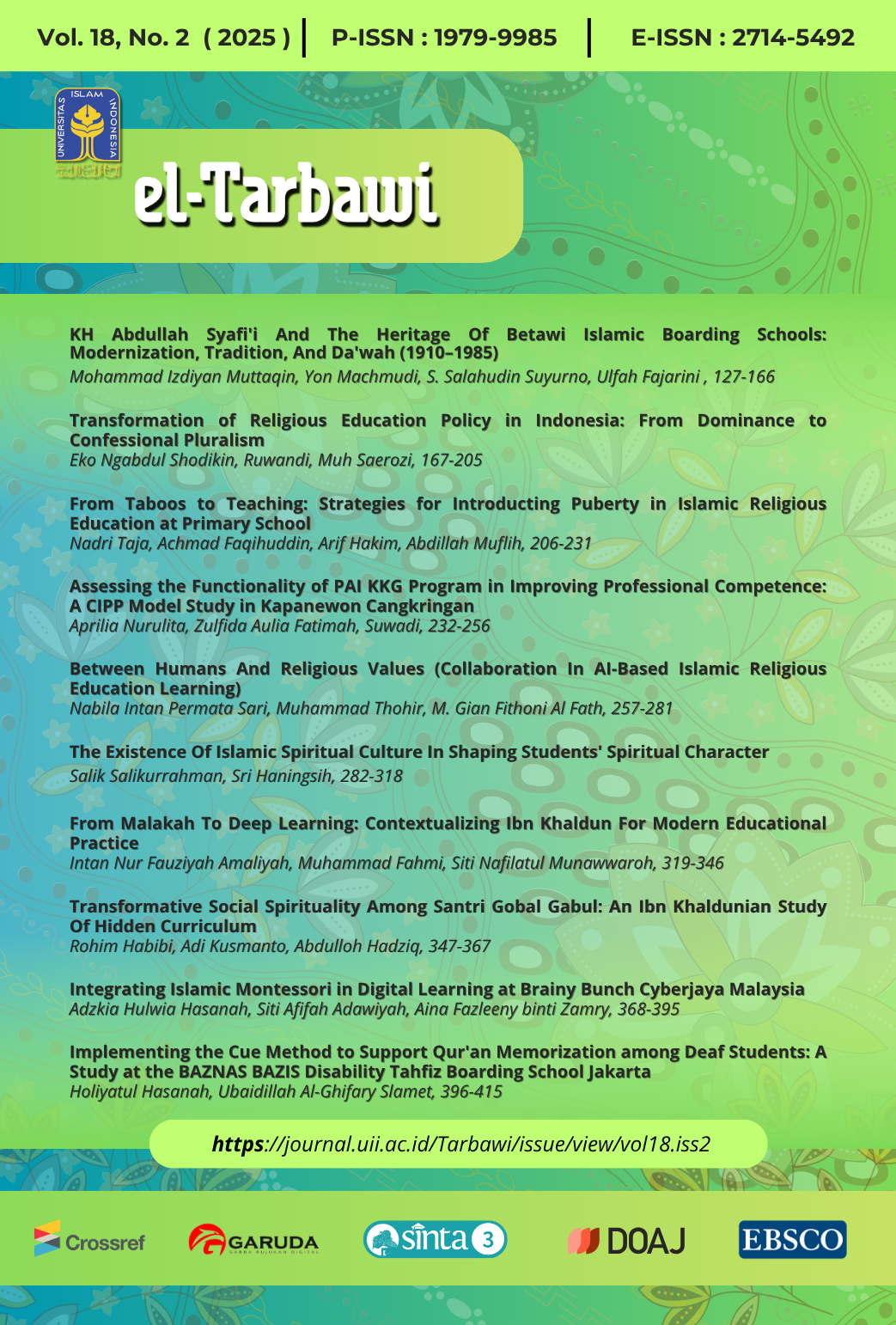
Main Article Content
Abstract
This study explores the transformative construction of social spirituality within the Santri Gobal Gabul community, a community-based religious movement affiliated with Pondok Pesantren Al-Muhammad Cepu. Drawing upon Ibn Khaldun’s Sociology of Education, it examines how the hidden curriculum of the Pengajian Malam Ahad (Saturday Night Recitation) functions as a form of non-formal education that transcends conventional pedagogical frameworks. The research focuses on three key dimensions: (1) reconstructing social spirituality through Ibn Khaldun’s concept of ‘ilm al-‘umran al-insani and the development of al-malakah (internalized moral competence); (2) identifying the mechanisms of the hidden curriculum that organically foster tolerance, empathy, and interfaith inclusivity; and (3) formulating a character education model grounded in social spirituality within the pesantren tradition. Employing a qualitative descriptive approach with a phenomenological lens, data were collected through in-depth interviews, participatory observation, and documentation, then validated through triangulation. The findings reveal that social spirituality is cultivated through ashabiyah khairiyyah (virtue-based social cohesion) emerging naturally within the hidden curriculum. Through moral exemplarity, reflective dialogue, and cross-cultural engagement, Pengajian Malam Ahad serves as a socio-spiritual laboratory (al-‘umran) that transforms individual piety into collective social consciousness.
Keywords
Article Details
Copyright (c) 2026 Rohim Habibi, Adi Kusmanto, Abdulloh Hadziq

This work is licensed under a Creative Commons Attribution-ShareAlike 4.0 International License.
Authors retain copyright and grant the journal right of first publication with the work simultaneously licensed under a Creative Commons Attribution (CC-BY-SA) 4.0 License that allows others to share the work with an acknowledgment of the work’s authorship and initial publication in this journal.
References
- Aisyah, S., Ilmi, M. U., Rosyid, M. A., Wulandari, E., & Akhmad, F. (2022). Kiai Leadership Concept in The Scope of Pesantren Organizational Culture. Tafkir: Interdisciplinary Journal of Islamic Education, 3(1), 40–59. https://doi.org/10.31538/tijie.v3i1.106 DOI: https://doi.org/10.31538/tijie.v3i1.106
- Apriliza, Y. (2022). Siklus Umran /Peradaban. Dakwatul Islam, 7(1), 49–58. https://doi.org/10.46781/dakwatulislam.v7i1.590 DOI: https://doi.org/10.46781/dakwatulislam.v7i1.590
- Arikunto, S. (2014). Prosedur Penelitian Suatu Pendekatan Praktek (4th ed.). Jakarta : Rineka Cipta.
- Azkia, Z. A., & Muslim, N. Z. (2024). Filsafat Pendidikan Islam: Kajian Pemikiran Ibnu Khaldun. Moral: Jurnal Kajian Pendidikan Islam, 1(4), 28-41. https://doi.org/10.61132/moral.v1i4.210 DOI: https://doi.org/10.61132/moral.v1i4.210
- Bable, E. (2002). The Basic of Social Research, (II). California : Wadsworth.
- Creswell, J. W. (2020). Educational Research: Planning, Conducting, and Evaluating Quantitative and Qualitative Research. Pearson Higher Ed.
- Darodjat, & Wahyudhiana. (2017). Memfungsikan Masjid Sebagai Pusat Pendidikan Untuk Membentuk Peradaban Islam. Islamadina : Jurnal Pemikiran Islam, 14(2), 1–13. https://doi.org/10.30595/islamadina.v0i0.1675
- Fitriyani, E. D., Mansur, A., & Syarnubi, S. (2020). Model Pembelajaran Pesantren Dalam Membina Moralitas Santri di Pondok Pesantren Sabilul Hasanah Banyuasin. Jurnal Pendidikan Agama Islam Raden Fatah, 2(1), 103–116. https://doi.org/10.19109/pairf.v2i1.4183 DOI: https://doi.org/10.19109/pairf.v2i1.4183
- Matin, Masykur, & Ahmad Gufron , I. . (2025). Kritik Ibn Khaldun terhadap Budaya dan Kekuasaan: Analisis Konsep Ashabiyyah’ dalam Muqaddimah. Arus Jurnal Sosial Dan Humaniora, 5(2), 1043–1049. https://doi.org/10.57250/ajsh.v5i2.1179 DOI: https://doi.org/10.57250/ajsh.v5i2.1179
- Habibi, R., Wahyuni, L. E. N., & Musfaah, U. R. (2025). The Transformation of Tolerance Attitudes Among Santri Gobal Gabul: A Multicultural Islamic Education Perspective . Al Ulya: Jurnal Pendidikan Islam, 10(2), 361–373. https://doi.org/10.32665/alulya.v10i2.5263 DOI: https://doi.org/10.32665/alulya.v10i2.5263
- Hadziq, A., Muqronul Faiz, M., & Fadhliyah, L. (2024). Spiritual Harmony: The Role Of Local Tradition In Building Interfaith Tolerance In Sengir. Harmoni, 23(2), 229–250. https://doi.org/10.32488/harmoni.v23i2.745 DOI: https://doi.org/10.32488/harmoni.v23i2.745
- Handayani, E. P., Zalnur, M., & Masyudi, F. (2025). Education and Social Dynamics from Ibn Khaldun’s Perspective: A Critical Review and Relevance for the Modern World. DIROSAT: Journal of Education, Social Sciences & Humanities, 3(2), 242–253. https://doi.org/10.58355/dirosat.v3i2.137 DOI: https://doi.org/10.58355/dirosat.v3i2.137
- Ilham, M. (2017). Konsep ‘Ashabiyah Dalam Pemikiran Politik Ibnu Khaldun. Jurnal Politik Profetik, 4(1), 1-13. https://doi.org/10.24252/profetik.v4i1a1
- Intan. (2019). Penerapan Pemikiran Al Umran Ibnu Khaldun Untuk Pemberdayaan Masyarakat. JURMA: Jurnal Program Mahasiswa Kreatif, 3(2), 67-71. https://doi.org/10.32832/pkm-p.v3i2.470 DOI: https://doi.org/10.32832/pkm-p.v3i2.470
- Ismail, H. (2022). Tuhan, Manusia Dan Masyarakat Perspektif Ibn Khaldun. Studi Multidisipliner: Jurnal Kajian Keislaman, 9(2), 108-120. https://doi.org/10.24952/multidisipliner.v9i2.5819 DOI: https://doi.org/10.24952/multidisipliner.v9i2.5819
- Kahfi, N., Hidayah, F., & Fadlullah, M. E. (2022). Konsep Tadrij Dan Takrir Ibnu Khaldun Sebagai Metode Pembelajaran. Mumtaz: Jurnal Pendidikan Agama Islam, 2(1), 1-18. https://doi.org/10.69552/mumtaz.v2i1.1688 DOI: https://doi.org/10.69552/mumtaz.v2i1.1688
- Khaldun, A.-A. A. bin M. bin. (2011). Mukaddimah Ibnu Khaldun (M. Ilham, M. Supar, & A. Zuhri (eds.); 3rd ed.). Pustaka Al-Kautsar.
- Kurniawan, R., Riswan, R., Azis, S. A., Herdi, H., & Yurna, Y (2023). Pemikiran Ibnu Khaldun Tentang filsafat Pendidikan Islam. Jurnal Riset Rumpun Agama Dan Filsafat, 2(2), 65–77. https://doi.org/10.55606/jurrafi.v2i2.1536 DOI: https://doi.org/10.55606/jurrafi.v2i2.1536
- Kusumawati, I., & Nurfuadi. (2024). Integrasi Kurikulum Pesantren Dalam Kurikulum Nasional Pada Pondok Pesantren Modern. Sanskara Pendidikan Dan Pengajaran, 2(1), 1–7. https://doi.org/10.58812/spp.v2i01.293 DOI: https://doi.org/10.58812/spp.v2i01.293
- Lestari, A. (2025). Pria Tewas Dikeroyok di Dalam Masjid, Sosiolog Sebut Fenomena Premanisme Lokal yang Merajalela. NU Online. https://www.nu.or.id/nasional/pria-tewas-dikeroyok-di-dalam-masjid-sosiolog-sebut-fenomena-premanisme-lokal-yang-merajalela-KDf82
- Miles, M. B., & Huberman. (2002). Kualitative Data Analysis (T. R. Rohidi (ed.)). Jakarta: Universitas Indonesia Press.
- Moleong, L. J. (2019). Metodologi Penelitian Kualitatif. Jakarta: Rosda Karya.
- Mujahidin, M., & Mustofa, S. P. I. T. A. (2024). Konsep Pendidikan Ibnu Khaldun dalam Buku Muqaddimah dan Relevansinya terhadap Kurikulum Merdeka Belajar. eprints.ums.ac.id. https://eprints.ums.ac.id/id/eprint/120148
- Partono, Illiyuuna, Q. N., Zafi, A. A., & Kamil, T. N. (2025). The Education Strategy of Anti-bullying Religious Moderation at School. Tarbawi: Jurnal Ilmu Pendidikan, 21(1), 1–10. https://doi.org/https://doi.org/10.32939/tarbawi.v21i1.4960
- Purnomo, S. (2017). Epistemologi Ibnu Khaldun Dan Pengembangan Pendidikan Islam. Jurnal Ilmiah Mahasiswa Raushan Fikr, 6(1), 39–54. https://doi.org/10.24090/jimrf.v6i1.2711 DOI: https://doi.org/10.24090/jimrf.v6i1.2711
- Rahmat, A. (2022). Analisis Data Kualitatif. In Metode Penelitian Kualitatif (1st ed., p. 222). PT. Tahta Media Group.
- Redaksi. (2025). Viral Pemuda Simeulue Dianiaya di Masjid, Jamaluddin Idham Desak Polisi Usut Tuntas Pelaku. AcehNews.Id. https://www.acehnews.id/news/viral-pemuda-simeulue-dianiaya-di-masjid-jamaluddin-idham-desak-polisi-usut-tuntas-pelaku/index.html
- Renawati, A. (2020). Upaya Pembentukkan Karakter Religius Siswa di Ma’had Ronggo Warsito MAN 2 Ponorogo. IAIN Ponorogo. https://etheses.iainponorogo.ac.id/9555/
- Syam, A. M., Dalimunthe, M. A., Suhendar, A., & Rambe, R. F. A. K. (2024). Islamic Philosophy: A Comparative Perspective Between Ibnu Khaldun And Karl Marx. SYAHADAT: Journal of Islamic Studies, 1(2), 55-72. https://doi.org/10.70489/syahadat.v1i2.336
- Taufiq, A., & Suryo, D. (2024). Educational Development of Indonesian Pesantren in the Perspective of Anthony Giddens’ Duality Social Change. Tafkir: Interdisciplinary Journal of Islamic Education, 5(4), 765–784. https://doi.org/10.31538/tijie.v5i4.2365 DOI: https://doi.org/10.31538/tijie.v5i4.2365
- Umagap, S., Salamor, L., & Gaite, T. (2022). Hidden Kuriculum (Kurikulum Tersembunyi) Sebagai Wujud Pendidikan Karakter (Studi pada SMK Al-Wathan Ambon). Jurnal Kewarganegaraan, 6(2), 5329–5334. https://doi.org/10.31316/jk.v6i2.3298
- Umam, N., Roqib, M., & Muarif, F., I. (2025). Masjid-Based Pesantren: Revitalizing the Role of Mosques as Centers of Islamic Education Rooted in Local Wisdom in Indonesia. Wah Academia Journal of Social Sciences, 4(1), 1380–1392. https://doi.org/10.63954/WAJSS.4.1.58.2025 DOI: https://doi.org/10.63954/WAJSS.4.1.58.2025
- Wijsen, F. (2021). Environmental Challenges in Indonesia: An Emerging Issue in the Social Study of Religion. Journal of Asian Social Science Research, 3(1), 1–14. https://doi.org/10.15575/jassr.v3i1.30 DOI: https://doi.org/10.15575/jassr.v3i1.30
References
Aisyah, S., Ilmi, M. U., Rosyid, M. A., Wulandari, E., & Akhmad, F. (2022). Kiai Leadership Concept in The Scope of Pesantren Organizational Culture. Tafkir: Interdisciplinary Journal of Islamic Education, 3(1), 40–59. https://doi.org/10.31538/tijie.v3i1.106 DOI: https://doi.org/10.31538/tijie.v3i1.106
Apriliza, Y. (2022). Siklus Umran /Peradaban. Dakwatul Islam, 7(1), 49–58. https://doi.org/10.46781/dakwatulislam.v7i1.590 DOI: https://doi.org/10.46781/dakwatulislam.v7i1.590
Arikunto, S. (2014). Prosedur Penelitian Suatu Pendekatan Praktek (4th ed.). Jakarta : Rineka Cipta.
Azkia, Z. A., & Muslim, N. Z. (2024). Filsafat Pendidikan Islam: Kajian Pemikiran Ibnu Khaldun. Moral: Jurnal Kajian Pendidikan Islam, 1(4), 28-41. https://doi.org/10.61132/moral.v1i4.210 DOI: https://doi.org/10.61132/moral.v1i4.210
Bable, E. (2002). The Basic of Social Research, (II). California : Wadsworth.
Creswell, J. W. (2020). Educational Research: Planning, Conducting, and Evaluating Quantitative and Qualitative Research. Pearson Higher Ed.
Darodjat, & Wahyudhiana. (2017). Memfungsikan Masjid Sebagai Pusat Pendidikan Untuk Membentuk Peradaban Islam. Islamadina : Jurnal Pemikiran Islam, 14(2), 1–13. https://doi.org/10.30595/islamadina.v0i0.1675
Fitriyani, E. D., Mansur, A., & Syarnubi, S. (2020). Model Pembelajaran Pesantren Dalam Membina Moralitas Santri di Pondok Pesantren Sabilul Hasanah Banyuasin. Jurnal Pendidikan Agama Islam Raden Fatah, 2(1), 103–116. https://doi.org/10.19109/pairf.v2i1.4183 DOI: https://doi.org/10.19109/pairf.v2i1.4183
Matin, Masykur, & Ahmad Gufron , I. . (2025). Kritik Ibn Khaldun terhadap Budaya dan Kekuasaan: Analisis Konsep Ashabiyyah’ dalam Muqaddimah. Arus Jurnal Sosial Dan Humaniora, 5(2), 1043–1049. https://doi.org/10.57250/ajsh.v5i2.1179 DOI: https://doi.org/10.57250/ajsh.v5i2.1179
Habibi, R., Wahyuni, L. E. N., & Musfaah, U. R. (2025). The Transformation of Tolerance Attitudes Among Santri Gobal Gabul: A Multicultural Islamic Education Perspective . Al Ulya: Jurnal Pendidikan Islam, 10(2), 361–373. https://doi.org/10.32665/alulya.v10i2.5263 DOI: https://doi.org/10.32665/alulya.v10i2.5263
Hadziq, A., Muqronul Faiz, M., & Fadhliyah, L. (2024). Spiritual Harmony: The Role Of Local Tradition In Building Interfaith Tolerance In Sengir. Harmoni, 23(2), 229–250. https://doi.org/10.32488/harmoni.v23i2.745 DOI: https://doi.org/10.32488/harmoni.v23i2.745
Handayani, E. P., Zalnur, M., & Masyudi, F. (2025). Education and Social Dynamics from Ibn Khaldun’s Perspective: A Critical Review and Relevance for the Modern World. DIROSAT: Journal of Education, Social Sciences & Humanities, 3(2), 242–253. https://doi.org/10.58355/dirosat.v3i2.137 DOI: https://doi.org/10.58355/dirosat.v3i2.137
Ilham, M. (2017). Konsep ‘Ashabiyah Dalam Pemikiran Politik Ibnu Khaldun. Jurnal Politik Profetik, 4(1), 1-13. https://doi.org/10.24252/profetik.v4i1a1
Intan. (2019). Penerapan Pemikiran Al Umran Ibnu Khaldun Untuk Pemberdayaan Masyarakat. JURMA: Jurnal Program Mahasiswa Kreatif, 3(2), 67-71. https://doi.org/10.32832/pkm-p.v3i2.470 DOI: https://doi.org/10.32832/pkm-p.v3i2.470
Ismail, H. (2022). Tuhan, Manusia Dan Masyarakat Perspektif Ibn Khaldun. Studi Multidisipliner: Jurnal Kajian Keislaman, 9(2), 108-120. https://doi.org/10.24952/multidisipliner.v9i2.5819 DOI: https://doi.org/10.24952/multidisipliner.v9i2.5819
Kahfi, N., Hidayah, F., & Fadlullah, M. E. (2022). Konsep Tadrij Dan Takrir Ibnu Khaldun Sebagai Metode Pembelajaran. Mumtaz: Jurnal Pendidikan Agama Islam, 2(1), 1-18. https://doi.org/10.69552/mumtaz.v2i1.1688 DOI: https://doi.org/10.69552/mumtaz.v2i1.1688
Khaldun, A.-A. A. bin M. bin. (2011). Mukaddimah Ibnu Khaldun (M. Ilham, M. Supar, & A. Zuhri (eds.); 3rd ed.). Pustaka Al-Kautsar.
Kurniawan, R., Riswan, R., Azis, S. A., Herdi, H., & Yurna, Y (2023). Pemikiran Ibnu Khaldun Tentang filsafat Pendidikan Islam. Jurnal Riset Rumpun Agama Dan Filsafat, 2(2), 65–77. https://doi.org/10.55606/jurrafi.v2i2.1536 DOI: https://doi.org/10.55606/jurrafi.v2i2.1536
Kusumawati, I., & Nurfuadi. (2024). Integrasi Kurikulum Pesantren Dalam Kurikulum Nasional Pada Pondok Pesantren Modern. Sanskara Pendidikan Dan Pengajaran, 2(1), 1–7. https://doi.org/10.58812/spp.v2i01.293 DOI: https://doi.org/10.58812/spp.v2i01.293
Lestari, A. (2025). Pria Tewas Dikeroyok di Dalam Masjid, Sosiolog Sebut Fenomena Premanisme Lokal yang Merajalela. NU Online. https://www.nu.or.id/nasional/pria-tewas-dikeroyok-di-dalam-masjid-sosiolog-sebut-fenomena-premanisme-lokal-yang-merajalela-KDf82
Miles, M. B., & Huberman. (2002). Kualitative Data Analysis (T. R. Rohidi (ed.)). Jakarta: Universitas Indonesia Press.
Moleong, L. J. (2019). Metodologi Penelitian Kualitatif. Jakarta: Rosda Karya.
Mujahidin, M., & Mustofa, S. P. I. T. A. (2024). Konsep Pendidikan Ibnu Khaldun dalam Buku Muqaddimah dan Relevansinya terhadap Kurikulum Merdeka Belajar. eprints.ums.ac.id. https://eprints.ums.ac.id/id/eprint/120148
Partono, Illiyuuna, Q. N., Zafi, A. A., & Kamil, T. N. (2025). The Education Strategy of Anti-bullying Religious Moderation at School. Tarbawi: Jurnal Ilmu Pendidikan, 21(1), 1–10. https://doi.org/https://doi.org/10.32939/tarbawi.v21i1.4960
Purnomo, S. (2017). Epistemologi Ibnu Khaldun Dan Pengembangan Pendidikan Islam. Jurnal Ilmiah Mahasiswa Raushan Fikr, 6(1), 39–54. https://doi.org/10.24090/jimrf.v6i1.2711 DOI: https://doi.org/10.24090/jimrf.v6i1.2711
Rahmat, A. (2022). Analisis Data Kualitatif. In Metode Penelitian Kualitatif (1st ed., p. 222). PT. Tahta Media Group.
Redaksi. (2025). Viral Pemuda Simeulue Dianiaya di Masjid, Jamaluddin Idham Desak Polisi Usut Tuntas Pelaku. AcehNews.Id. https://www.acehnews.id/news/viral-pemuda-simeulue-dianiaya-di-masjid-jamaluddin-idham-desak-polisi-usut-tuntas-pelaku/index.html
Renawati, A. (2020). Upaya Pembentukkan Karakter Religius Siswa di Ma’had Ronggo Warsito MAN 2 Ponorogo. IAIN Ponorogo. https://etheses.iainponorogo.ac.id/9555/
Syam, A. M., Dalimunthe, M. A., Suhendar, A., & Rambe, R. F. A. K. (2024). Islamic Philosophy: A Comparative Perspective Between Ibnu Khaldun And Karl Marx. SYAHADAT: Journal of Islamic Studies, 1(2), 55-72. https://doi.org/10.70489/syahadat.v1i2.336
Taufiq, A., & Suryo, D. (2024). Educational Development of Indonesian Pesantren in the Perspective of Anthony Giddens’ Duality Social Change. Tafkir: Interdisciplinary Journal of Islamic Education, 5(4), 765–784. https://doi.org/10.31538/tijie.v5i4.2365 DOI: https://doi.org/10.31538/tijie.v5i4.2365
Umagap, S., Salamor, L., & Gaite, T. (2022). Hidden Kuriculum (Kurikulum Tersembunyi) Sebagai Wujud Pendidikan Karakter (Studi pada SMK Al-Wathan Ambon). Jurnal Kewarganegaraan, 6(2), 5329–5334. https://doi.org/10.31316/jk.v6i2.3298
Umam, N., Roqib, M., & Muarif, F., I. (2025). Masjid-Based Pesantren: Revitalizing the Role of Mosques as Centers of Islamic Education Rooted in Local Wisdom in Indonesia. Wah Academia Journal of Social Sciences, 4(1), 1380–1392. https://doi.org/10.63954/WAJSS.4.1.58.2025 DOI: https://doi.org/10.63954/WAJSS.4.1.58.2025
Wijsen, F. (2021). Environmental Challenges in Indonesia: An Emerging Issue in the Social Study of Religion. Journal of Asian Social Science Research, 3(1), 1–14. https://doi.org/10.15575/jassr.v3i1.30 DOI: https://doi.org/10.15575/jassr.v3i1.30