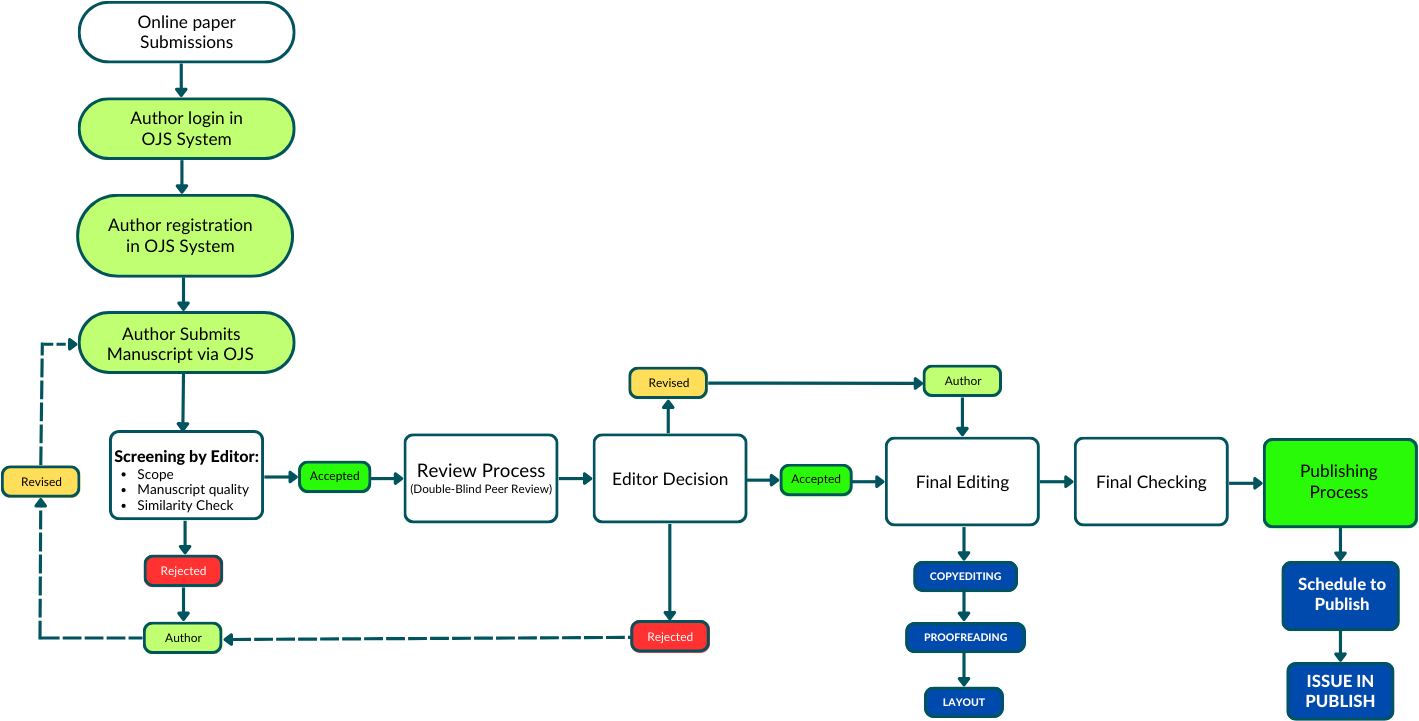
Peer Review Process
Reviewers are selected based on their expertise in the subject matter of the manuscript.
-
The peer review process follows a double-blind system, with all steps conducted through the OJS (Open Journal System) platform.
-
The Editor-in-Chief or Managing Editor and editorial staff initially assess the manuscript for compliance with the journal’s scope and standards. Manuscripts that fall outside the scope will be rejected, while those not meeting the required standards will be returned to authors for revision.
-
Each submission undergoes a plagiarism check using TURNITIN. The Editor-in-Chief evaluates the similarity report and may either reject the manuscript or request the authors to revise sections with excessive similarity.
-
If the manuscript meets the journal's scope and passes the plagiarism check, an Editor is assigned and two reviewers are invited.
-
If both reviewers recommend rejection, the article is rejected. In case of conflicting decisions, two additional reviewers are invited for further evaluation.
-
The Editor may also request clarifications or revisions from the authors either independently or in conjunction with reviewer comments.
-
Typically, there is one round of review, but a second round may be initiated if the manuscript requires substantial revisions.
-
The timeframe for authors to submit revisions depends on the complexity of the required changes. If the revised manuscript is not returned within the allotted time, the manuscript may be rejected. Authors may still submit it again as a new submission.
-
Based on reviewers’ feedback, the Editor or Editorial Board makes a decision. The possible outcomes are:
-
Accept Submission: The manuscript is accepted without revision.
-
Revisions Required: Minor changes are needed before acceptance.
-
Resubmit for Review: Major revisions are required; the manuscript must go through another round of review.
-
Decline Submission: The manuscript is not accepted for publication.
-
Further details on the peer review process are illustrated in the flowchart below.